Within UAP Disclosure
Why Public Trust Is the Real UFO Battlefield
Disclosure politics are driven by a trust gap between official caution, missing data, and public suspicion of secrecy.
On this page
- Why official statements fail to settle doubts
- How transparency can build or damage trust
- What credible institutions would need to show
Page outline Jump by section
Introduction
Public trust is the central battlefield of the UFO disclosure movement because the dispute is no longer only about strange objects. It is about whether official institutions can be believed when they say they have found no verified extraterrestrial technology, while also admitting that many reports remain unresolved, poorly documented, or hidden behind classification. That gap lets two stories survive at once: the official story of limited evidence, and the public story of withheld truth.
The result is a credibility trap. When agencies release cautious reports, sceptics see responsible restraint, but many disclosure advocates see another layer of evasion. When politicians hold hearings with dramatic claims but little hard evidence, believers feel vindicated, while doubters see rumour dressed up as oversight. Trust will not be rebuilt by a single statement from the Pentagon, NASA, Congress, or any whistleblower. It depends on whether UAP institutions can show their methods, explain uncertainty, protect witnesses, release records, and admit where evidence simply is not strong enough.
Why official statements fail to settle doubts
The All-domain Anomaly Resolution Office, or AARO, is the main US government body tasked with investigating unidentified anomalous phenomena. It says it uses a rigorous, data-driven framework, and the Department of Defence has stated that AARO has found no verifiable evidence of extraterrestrial beings, activity, or technology. In its 2024 reporting, AARO received 757 UAP reports for the period covered, said many resolved cases involved balloons, birds, drones, satellites or aircraft, and noted that more than 900 reports still lacked enough scientific data for analysis. That mixture of denial and incompleteness is exactly why official conclusions often do not end public suspicion.[U.S. Department of War]war.govDOD Examining Unidentified Anomalous Phenomena > U.S. Department of War > Defense Department News | U.S. Department of War…(https://www.war.gov/News/News-Stories/Article/Article/3965403/dod-examining-unidentified-anomalous-phenomena/)
AARO’s historical review sharpened the problem. Its public conclusion was that US government investigations, academic-sponsored research, and official review panels had not confirmed any UAP sighting as extraterrestrial technology; it also found no empirical evidence for claims that the government or private companies had reverse-engineered extraterrestrial technology. But the same topic has a long history of classified programmes, changing terminology, partial releases, and public messaging that many citizens already distrust. A denial from an institution suspected of secrecy does not function like a denial from a neutral observer.[U.S. Department of War]war.govDOD Examining Unidentified Anomalous Phenomena > U.S. Department of War > Defense Department News | U.S. Department of War…(https://www.war.gov/News/News-Stories/Article/Article/3701297/dod-report-discounts-sightings-of-extraterrestrial-technology/)
The public polling reflects that gap. A March 2024 YouGov survey found that more than 60% of Americans believed the US government was concealing information about UFOs, while only 11% said the government had told the public everything it knew. The same survey found that only about one in three Americans believed the Pentagon’s recent report. This does not prove that hidden alien technology exists. It shows something more politically important for the disclosure movement: official evidence standards and public credibility standards are badly misaligned.[YouGov]yougov.comSource details in endnotes.
Part of the problem is that “unresolved” is easy to misunderstand. In scientific and intelligence work, an unresolved case often means the available sensor data, metadata, witness detail, or environmental context is too weak to identify the object confidently. In public debate, unresolved cases can be treated as positive evidence that something extraordinary has been concealed. AARO has said some cases require sustained scientific inquiry, but it has also said none of its resolved cases has pointed to advanced capabilities or breakthrough technologies. That cautious distinction is accurate but politically fragile: it asks the public to trust both the institution’s uncertainty and its negative conclusion.[U.S. Department of War]war.govDOD Examining Unidentified Anomalous Phenomena > U.S. Department of War > Defense Department News | U.S. Department of War…(https://www.war.gov/News/News-Stories/Article/Article/3965403/dod-examining-unidentified-anomalous-phenomena/)
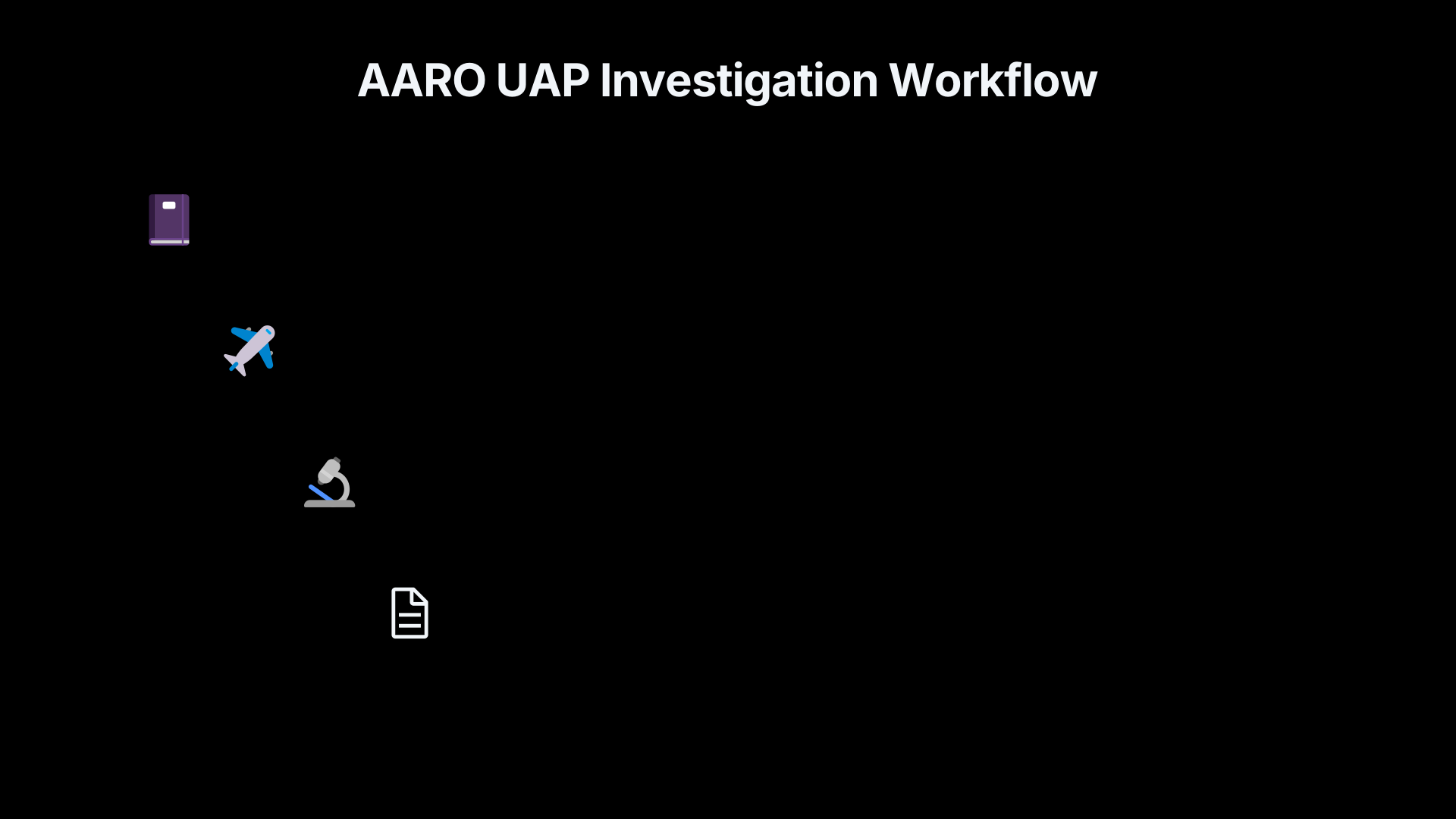
The trust gap is built into the evidence problem
UAP institutions are trying to investigate a subject where the evidence is often produced under poor conditions: distant lights, brief encounters, classified sensors, incomplete radar tracks, pilot recollections, compressed video, or reports stripped of operational context. NASA’s independent study team stated plainly that current UAP analysis is hampered by poor sensor calibration, lack of multiple measurements, missing sensor metadata, and the absence of baseline data. That is not just a technical problem. It is a trust problem, because weak data leaves room for both official dismissal and conspiratorial certainty.[NASA Science]science.nasa.govSource details in endnotes.
NASA also identified stigma as a direct cause of missing evidence. If pilots, service members, scientists, or civilian observers fear ridicule or career consequences, they may not report sightings promptly or at all. The NASA panel argued that the agency’s public trust could help reduce stigma and model transparent, rigorous investigation. This matters because institutions cannot build confidence by saying “we need better data” while maintaining a culture that discourages witnesses from producing that data.[NASA Science]science.nasa.govSource details in endnotes.
RAND’s analysis of more than 101,000 public UAP reports illustrates why transparency has to be more than releasing sensational cases. RAND found that reports were more likely near military operations areas and recommended better public outreach about authorised aircraft activity, as well as a more robust public reporting system designed to minimise hoaxes and misidentified objects. In other words, some distrust may be reduced by mundane clarity: telling people when military or aviation activity is likely to be visible, and giving them a reporting channel that separates useful observations from noise.[RAND Corporation]rand.orgSource details in endnotes.
This is where UAP trust differs from ordinary science communication. A climate agency, health regulator, or space agency can publish data and methods in a relatively established field. UAP offices operate where national security secrecy, popular culture, witness stigma, intelligence compartmentalisation, and anomalous evidence all collide. The public is not only asking, “What did you find?” It is asking, “What were you allowed to look at, what could not be released, and who checks whether you are telling us the whole story?”
Transparency can build trust, but badly handled transparency can damage it
The clearest institutional move towards transparency is the creation of the National Archives’ UAP Records Collection. Under the 2024 National Defence Authorisation Act, NARA established Record Group 615 for UAP records and says it will add records on a rolling basis as agencies identify, prepare, and transfer them. This matters because durable trust is easier to build around archives than press conferences. Records can be re-read, compared, challenged, and used by researchers outside government.[National Archives]archives.govSource details in endnotes.
But record release is not automatically trust-building. If files arrive with heavy redactions, poor indexing, missing context, or no explanation of why material remains classified, each release can become a fresh trigger for suspicion. The disclosure movement is especially sensitive to “document theatre”: the appearance of openness without the release of enough information to test claims. A public archive helps only if it is searchable, regularly updated, clearly scoped, and paired with explanations that distinguish national security withholding from institutional embarrassment or bureaucratic delay.
Congressional hearings have a similar double edge. They can force agencies to answer questions in public, normalise discussion of UAP reporting, and create political pressure for whistleblower protections. The House Oversight Committee’s 2025 hearing on “Restoring Public Trust Through UAP Transparency and Whistleblower Protection” explicitly framed the issue around disclosure, AARO, the intelligence community, witness protection, and public confidence.[Oversight Committee]oversight.house.govSource details in endnotes.
Yet hearings can also widen the trust gap when dramatic allegations outpace verifiable evidence. In the 2024 House UAP hearing, witnesses made claims about secret retrieval programmes and hidden evidence, while press coverage noted the lack of direct physical proof and the Pentagon’s continuing denial of verified extraterrestrial programmes. For disclosure advocates, that can look like courageous testimony meeting institutional stonewalling. For sceptics, it can look like Congress amplifying claims without evidential discipline. Both reactions are predictable, and both show why transparency without verification can intensify rather than settle the dispute.[The Guardian]theguardian.comSource details in endnotes.
The credibility problem is not just “government versus believers”
A common mistake is to reduce UAP trust politics to a fight between official agencies and UFO believers. The real map is messier. There are military witnesses who want reporting channels but do not claim alien craft. There are sceptics who support disclosure because they want to identify drones, balloons, satellites, sensor artefacts, or classified aircraft. There are lawmakers who frame the issue as intelligence oversight and wasteful spending, not extraterrestrial proof. There are researchers who think the topic deserves scientific study precisely because the evidence is weak, fragmented, and socially stigmatised.
Academic interest has also become part of the trust debate. A 2023 study of 1,460 tenured and tenure-track faculty across 14 disciplines found that faculty respondents generally considered academic evaluation of UAP information and more research important, with curiosity outweighing scepticism or indifference. That finding does not validate extraordinary claims. It suggests that one way to rebuild credibility is to move UAP evaluation away from closed institutional assertion and towards transparent methods that outside experts can scrutinise.[Nature]nature.comSource details in endnotes.
Independent scientific projects point in the same direction. The Galileo Project’s proposed UAP observatories emphasise multimodal, multispectral instruments, triangulation, environmental sensors, radar-derived measurements, and methods designed to distinguish artefacts from corroborated detections. The importance of such work is less that it promises spectacular answers and more that it changes the trust model: instead of relying primarily on witnesses, leaks, or classified sensors, it tries to create public, calibrated, repeatable evidence streams.[arXiv]arxiv.orgSource details in endnotes.
This is also why ordinary explanations should not be treated as trust failures. When a sighting is identified as Starlink satellites, a drone, a weather balloon, a bird, or a sensor artefact, that can strengthen credibility if the explanation is shown clearly. A 2024 aviation case study showed how a Starlink satellite train could be misidentified as UAP by pilots and reconstructed using orbital data and flight information. That sort of transparent resolution is more persuasive than a bare official label saying “identified”.[arXiv]arxiv.orgSource details in endnotes.
What credible UAP institutions would need to show
Trustworthy UAP institutions do not need to promise extraordinary revelations. They need to show that their processes are strong enough to earn confidence even when the answer is disappointing, classified, or incomplete. The key test is whether the public can see the difference between “we do not know yet”, “we know but cannot release it”, “we know and it is ordinary”, and “the claim is unsupported”.
A credible institutional system would need several visible features:
- Clear case categories: Agencies should separate resolved identifications, unresolved low-data cases, unresolved high-quality cases, suspected foreign or domestic technology, and claims about alleged legacy programmes. Lumping all uncertainty together encourages speculation.
- Minimum evidence standards: Each released case should say what data exists, what is missing, what analysis was performed, and why a conclusion was or was not reached.
- Independent review pathways: Outside scientists, aviation experts, sensor specialists, archivists, and inspectors general should have defined roles, especially where public claims involve classified programmes or contractor records.
- Protected reporting channels: Pilots, service members, contractors, and intelligence personnel need routes to submit information without stigma or retaliation, while still allowing penalties for hoaxes or knowingly false claims.
- Transparent redaction logic: Withheld material should be tied to specific national security, privacy, or operational reasons wherever possible. Vague secrecy corrodes trust even when withholding is legitimate.
- A public archive with continuity: NARA’s UAP collection is valuable because it creates a standing record rather than a one-off release. Its trust value will depend on completeness, metadata, indexing, and agency compliance over time.[National Archives]archives.govSource details in endnotes.
The hardest requirement is institutional humility. UAP offices must be able to say that some reports are interesting but not evidentially decisive; that some whistleblower claims deserve investigation but are not proof; that some secrecy is legitimate but over-classification can damage democracy; and that unresolved cases should not be inflated into conclusions. This is not a public relations posture. It is the only way to avoid feeding both blind trust and reflexive suspicion.
Why the disclosure movement persists
The disclosure movement persists because public trust has not caught up with institutional procedure. AARO can publish a report saying it has found no verifiable evidence of extraterrestrial technology, NASA can call for better calibrated data, Congress can demand whistleblower protections, and the National Archives can build a UAP records collection. Each step is meaningful, but none alone answers the deeper question: who gets to know what the state knows, and how can citizens tell the difference between secrecy, uncertainty, and evasion? U.S. Department of War[NASA Science]science.nasa.govSource details in endnotes.
That is why the “real UFO battlefield” is institutional credibility. If future releases provide only fragments, public suspicion will harden. If hearings elevate claims without evidence, public debate will polarise further. If agencies explain methods, release records, protect serious witnesses, and let independent experts test what can be tested, trust may improve even without a dramatic revelation.
The strongest version of UAP transparency is therefore not a promise that the most extraordinary claims are true. It is a system capable of proving ordinary explanations when they fit, preserving genuinely unresolved cases when they do not, and showing the public enough of the process to make institutional caution look like evidence discipline rather than concealment.
Amazon book picks
Further Reading
Books and field guides related to Why Public Trust Is the Real UFO Battlefield. Use these as the next step if you want deeper reading beyond the article.
UFOs
Shows how official witnesses can both build trust and leave uncertainty unresolved.
American Cosmic
Explains why UFO disclosure is also a trust, belief, and authority problem.
The Demon-Haunted World
Rating: 4.5/5 from 43 Google Books ratings
Helps frame trust around evidence, uncertainty, and extraordinary claims.
eBay marketplace picks
Marketplace Samples
Example marketplace items related to this page. Use the search link to explore similar finds on eBay.




Endnotes
1.
Source: war.gov
Title: U.S. Department of War
Link:https://www.war.gov/News/News-Stories/Article/Article/3965403/dod-examining-unidentified-anomalous-phenomena/
Source snippet
DOD Examining Unidentified Anomalous Phenomena > U.S. Department of War > Defense Department News | U.S. Department of War...
2.
Source: aaro.mil
Link:https://www.aaro.mil/
3.
Source: war.gov
Title: U.S. Department of War
Link:https://www.war.gov/News/News-Stories/Article/Article/3701297/dod-report-discounts-sightings-of-extraterrestrial-technology/
Source snippet
DOD Report Discounts Sightings of Extraterrestrial Technology > U.S. Department of War > Defense Department News | U.S. Department of War...
4.
Source: yougov.com
Link:https://yougov.com/en-us/articles/48928-is-something-out-there-americans-government-secrets-ufos
5.
Source: science.nasa.gov
Link:https://science.nasa.gov/wp-content/uploads/2023/09/uap-independent-study-team-final-report.pdf
6.
Source: rand.org
Link:https://www.rand.org/pubs/research_reports/RRA2475-1.html
7.
Source: archives.gov
Link:https://www.archives.gov/research/topics/uaps
8.
Source: oversight.house.gov
Link:https://oversight.house.gov/release/hearing-wrap-up-government-must-be-more-transparent-about-uaps/
9.
Source: nature.com
Link:https://www.nature.com/articles/s41599-023-01746-3
10.
Source: arxiv.org
Link:https://arxiv.org/abs/2305.18566
11.
Source: arxiv.org
Link:https://arxiv.org/abs/2403.08155
12.
Source: aaro.mil
Link:https://www.aaro.mil/UAP-Cases/Official-UAP-Imagery/
13.
Source: aaro.mil
Title: AARO Historical Record Report Vol 1 2024
Link:https://www.aaro.mil/Portals/136/PDFs/AARO_Historical_Record_Report_Vol_1_2024.pdf
14.
Source: oversight.house.gov
Title: unidentified anomalous phenomena exposing the truth
Link:https://oversight.house.gov/hearing/unidentified-anomalous-phenomena-exposing-the-truth/
15.
Source: oversight.house.gov
Title: luna continues transparency investigation into uaps
Link:https://oversight.house.gov/release/luna-continues-transparency-investigation-into-uaps/
16.
Source: oversight.house.gov
Title: Dave G HOC Speech FINAL For Trans
Link:https://oversight.house.gov/wp-content/uploads/2023/07/Dave_G_HOC_Speech_FINAL_For_Trans.pdf
17.
Source: docs.house.gov
Title: HHRG 118 GO12 Wstate ShellenbergerM 20241113
Link:https://docs.house.gov/meetings/GO/GO12/20241113/117721/HHRG-118-GO12-Wstate-ShellenbergerM-20241113.pdf
18.
Source: oversight.house.gov
Title: restoring public trust through uap transparency and whistleblower protection
Link:https://oversight.house.gov/hearing/restoring-public-trust-through-uap-transparency-and-whistleblower-protection/
19.
Source: archives.gov
Title: rfk files uap records april 2025
Link:https://www.archives.gov/news/articles/rfk-files-uap-records-april-2025
Published: april 2025
20.
Source: archives.gov
Title: uap guidance
Link:https://www.archives.gov/records-mgmt/uap-guidance
21.
Source: archives.gov
Link:https://www.archives.gov/research/topics/uaps/faqs
23.
Source: archives.gov
Link:https://www.archives.gov/press/press-releases/2025/nr25-07
24.
Source: war.gov
Link:https://www.war.gov/ufo/
25.
Source: war.gov
Title: department of defense releases the annual report on unidentified anomalous phen
Link:https://www.war.gov/News/Releases/Release/Article/3964824/department-of-defense-releases-the-annual-report-on-unidentified-anomalous-phen/
26.
Source: science.nasa.gov
Link:https://science.nasa.gov/uap/faqs/
27.
Source: science.nasa.gov
Link:https://science.nasa.gov/uap/
28.
Source: theguardian.com
Link:https://www.theguardian.com/us-news/2024/nov/13/house-ufo-hearing
29.
Source: facebook.com
Link:https://www.facebook.com/DepartmentofWar/posts/breaking-over-1-billion-users-around-the-world-have-visited-wargovufothe-second-/1437062565126671/
Additional References
30.
Source: reuters.com
Link:https://www.reuters.com/technology/space/pentagon-ufo-report-says-most-sightings-ordinary-objects-phenomena-2024-03-08/
Source snippet
Pentagon UFO report says most sightings 'ordinary objects' and phenomena | Reuters...
31.
Source: youtube.com
Title: Public Meeting on Unidentified Anomalous Phenomena (Official NASA Broadcast)
Link:https://www.youtube.com/watch?v=bQo08JRY0iM
Source snippet
House holds hearing on UFO transparency and whistleblower protection | full video...
32.
Source: youtube.com
Link:https://www.youtube.com/watch?v=mu9mw6GHPEM
Source snippet
House holds hearing on UFOs, government transparency | full video...
33.
Source: democrats.senate.gov
Link:https://www.democrats.senate.gov/newsroom/press-releases/schumer-rounds-introduce-new-legislation-to-declassify-government-records-related-to-unidentified-anomalous-phenomena-and-ufos_modeled-after-jfk-assassination-records-collection-act–as-an-amendment-to-ndaa
34.
Source: youtube.com
Title: House holds hearing on UFOs, government transparency | full video
Link:https://www.youtube.com/watch?v=SNgoul4vyDM
Source snippet
Key moments at House UFO transparency hearing...
35.
Source: youtube.com
Title: Key moments at House UFO transparency hearing
Link:https://www.youtube.com/watch?v=Y0Sjv30bCio
Source snippet
Replay! NASA's Release of the Unidentified Anomalous Phenomena Report...
36.
Source: defensescoop.com
Link:https://defensescoop.com/2026/05/14/uap-trump-first-pursue-ufo-file-drop/
37.
Source: aui.edu
Link:https://aui.edu/aaro-releases-report-on-unidentified-anomalous-phenomena-uap/
38.
Source: lamag.com
Link:https://lamag.com/news-and-politics/of-course-something-is-going-on-congress-dodges-questions-on-missing-scientists-at-ufo-transparency-push/
39.
Source: commons.wikimedia.org
Link:https://commons.wikimedia.org/wiki/File%3A2023House_Oversight_and_Accountability_Hearing_on_UAP%E2%80%93Unidentified_Anomalous_Phenomena%E2%80%93_Implications_on_National_Security%2C_Public_Safety%2C_and_Government_Transparency.webm
Topic Tree