Within UAP Disclosure
Could a JFK Style Law Unlock UAP Files?
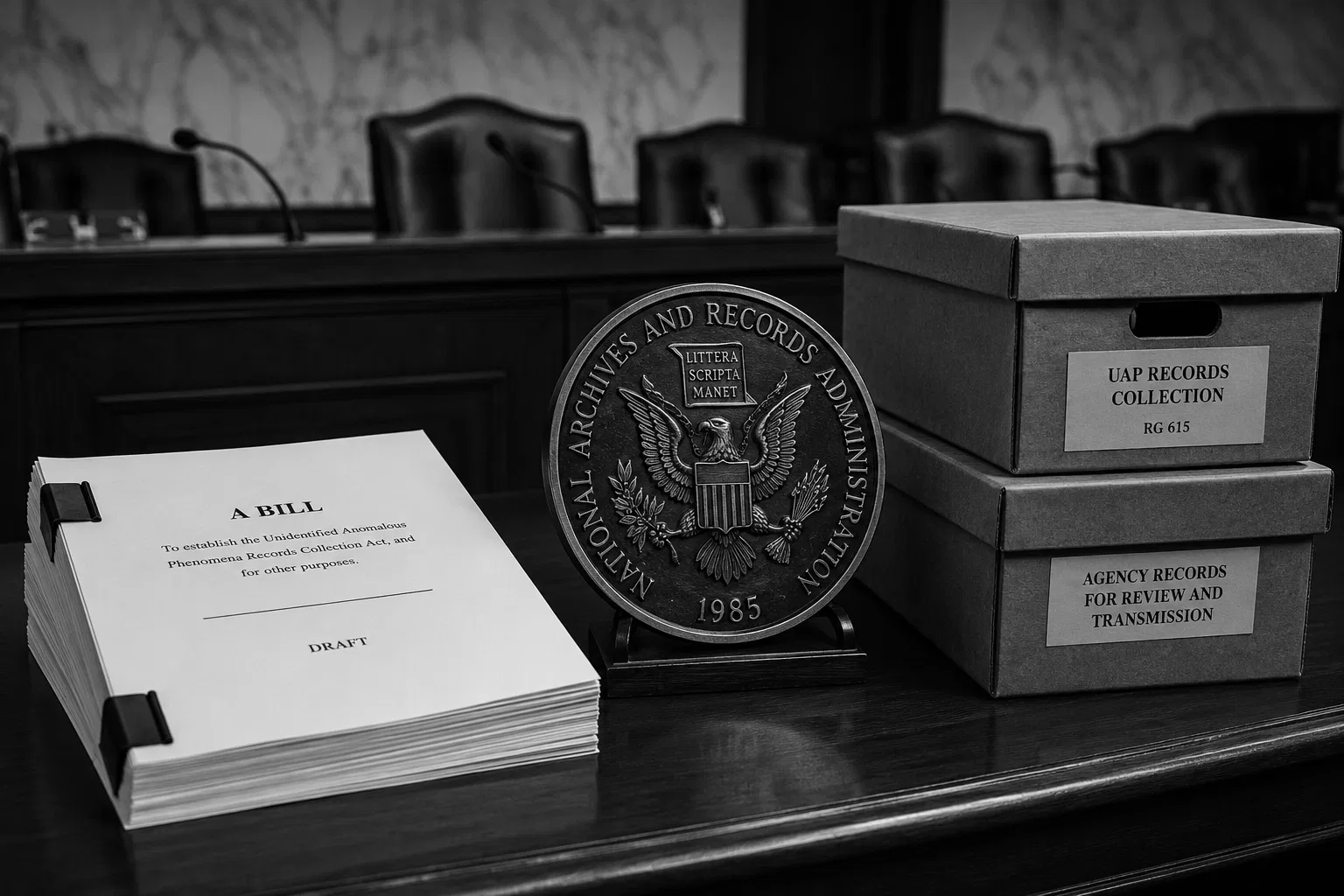
The Schumer-Rounds proposal matters because it tried to model UAP disclosure on a formal historical-records process.
On this page
- What the proposal tried to create
- Why the JFK records model matters
- What legislation can and cannot force
Page outline Jump by section
Introduction
The Schumer-Rounds UAP Disclosure Act proposal was one of the most concrete attempts to turn the UFO disclosure movement into a formal records law. Rather than asking the public simply to trust new hearings, whistleblowers, or agency statements, it proposed a JFK-style process: centralise UAP records at the National Archives, presume disclosure, force agencies to justify continued secrecy, and create an independent review board to adjudicate contested records. Its importance lies less in proving any particular UAP claim and more in changing the governance question: who controls the files, who can delay release, and what standard must secrecy meet?[senate]democrats.senate.govDemocratic Leadership BAG23A78Senate Democratic LeadershipBAG23A78…
The proposal did not pass in full. A narrower version became part of the Fiscal Year 2024 National Defense Authorization Act, requiring the National Archives and Records Administration, or NARA, to establish an Unidentified Anomalous Phenomena Records Collection and requiring agencies to review, identify, organise, and transmit relevant records. The provisions that most excited disclosure advocates — especially an independent UAP Records Review Board and eminent-domain authority over UAP-related materials held outside government — were not included in the final law.[National Archives]archives.govNational Archives Guidance to Federal Agencies on Unidentified AnomalousNational Archives Guidance to Federal Agencies on Unidentified Anomalous
What the Proposal Tried to Create
The proposal, led by Senate Majority Leader Chuck Schumer and Senator Mike Rounds with a bipartisan group of co-sponsors, was introduced as an amendment to the 2024 defence authorisation bill. Schumer’s office described it as modelled on the President John F. Kennedy Assassination Records Collection Act of 1992, with a presumption that government UAP records should be disclosed rather than withheld by default.[senate]democrats.senate.govDemocratic Leadership BAG23A78Senate Democratic LeadershipBAG23A78…
Its first major mechanism was a dedicated UAP Records Collection at NARA. That mattered because disclosure debates often stall at the same question: even if records exist, are they scattered across military commands, intelligence agencies, contractors, archives, and classification systems in ways that make public access practically impossible? The proposal tried to answer that by requiring government offices to identify and organise UAP-related records and prepare them for transmission to the Archivist of the United States.[senate]democrats.senate.govDemocratic Leadership BAG23A78Senate Democratic LeadershipBAG23A78…
A second mechanism was preservation. The draft prohibited UAP records from being destroyed, altered, or mutilated, a provision aimed at one of the disclosure movement’s central anxieties: that delay is not neutral if records can disappear, be fragmented, or remain buried inside agency systems before anyone outside that agency can assess them.[senate]democrats.senate.govDemocratic Leadership BAG23A78Senate Democratic LeadershipBAG23A78…
A third mechanism was structured postponement. The proposal did not say every UAP record must be dumped immediately, regardless of national security or privacy. It instead created grounds for postponing disclosure, using a “clear and convincing evidence” standard and requiring secrecy to be justified by harms such as exposing intelligence sources or methods, endangering a confidential source, invading personal privacy, or damaging foreign relations in a way that outweighed the public interest.[senate]democrats.senate.govDemocratic Leadership BAG23A78Senate Democratic LeadershipBAG23A78…
The most consequential proposed addition was an independent Unidentified Anomalous Phenomena Records Review Board. Under the draft, the President would nominate, with Senate confirmation, nine US citizens to oversee review, transmission to NARA, and public disclosure of UAP records. This would have moved key disclosure decisions away from the same agencies that created, classified, or held the records.[senate]democrats.senate.govDemocratic Leadership BAG23A78Senate Democratic LeadershipBAG23A78…
Why the JFK Records Model Matters
The JFK model matters because it treats public distrust as a records-management and governance problem, not only as a public-relations problem. After decades of controversy over the Kennedy assassination, Congress created a central records collection and an independent Assassination Records Review Board to re-examine records that agencies still considered too sensitive to release. NARA states that the JFK board completed its work in 1998, issued a final report, and transferred its records to the National Archives.[National Archives]archives.govNational Archives Guidance to Federal Agencies on Unidentified AnomalousNational Archives Guidance to Federal Agencies on Unidentified Anomalous
That model has a specific philosophy: the public interest is not satisfied by ordinary Freedom of Information Act requests alone. A historical-records law can define a universe of records, create deadlines, centralise copies, require agencies to search their holdings, and force written explanations when secrecy continues. NARA’s own audit history of the JFK process notes that the JFK Act used a “presumption of immediate disclosure” and created both a central collection and an independent review board.[National Archives]archives.govNational Archives Guidance to Federal Agencies on Unidentified AnomalousNational Archives Guidance to Federal Agencies on Unidentified Anomalous
The Schumer-Rounds proposal borrowed that architecture because UAP disclosure advocates argue that ordinary declassification channels are too slow, too agency-controlled, and too vulnerable to narrow interpretations of relevance. The draft’s “public interest” definition explicitly framed disclosure as a way to inform the public about the history of the federal government’s knowledge and involvement surrounding UAP.[senate]democrats.senate.govDemocratic Leadership BAG23A78Senate Democratic LeadershipBAG23A78…
The analogy is not perfect. The Kennedy assassination is a single historical event with a defined date, victim, and investigative record. UAP is a broader category covering sightings, sensor reports, military encounters, possible aerospace or intelligence equities, and disputed claims about “technologies of unknown origin” or “non-human intelligence”. That makes the definition of relevant records harder and more politically sensitive. But that is also why the review-board idea mattered: it would have created a referee for disputes over whether a record counted and whether continued secrecy was justified.[fas]sgp.fas.orgSource details in endnotes. Project on Government Secrecy
The Parts That Survived
The final FY2024 law preserved the central archive concept but removed much of the proposed independent enforcement machinery. NARA says Public Law 118-31, sections 1841 to 1843, required it to establish the Unidentified Anomalous Phenomena Records Collection, and that each federal agency had to review, identify, and organise UAP records in its custody for disclosure and transmission to NARA.[National Archives]archives.govNational Archives Guidance to Federal Agencies on Unidentified AnomalousNational Archives Guidance to Federal Agencies on Unidentified Anomalous
NARA has since established Record Group 615, the Unidentified Anomalous Phenomena Records Collection. It describes the collection as the destination for UAP records received from federal agencies under the 2024 NDAA. This is a concrete institutional change: UAP records are no longer only a subject of hearings or agency reports, but also a named archival category inside the US national records system.[National Archives]archives.govNational Archives Guidance to Federal Agencies on Unidentified AnomalousNational Archives Guidance to Federal Agencies on Unidentified Anomalous
The final law still uses postponement criteria. NARA’s access-restriction list includes UAP Records Collection postponement codes for threats to military defence, intelligence operations, foreign relations, protected intelligence agents, sources and methods, privacy interests, confidentiality understandings, and classified national-security information. That means the law created a disclosure pathway, but also a structured vocabulary for withholding records.[National Archives]archives.govNational Archives Guidance to Federal Agencies on Unidentified AnomalousNational Archives Guidance to Federal Agencies on Unidentified Anomalous
For government contractors and research entities, the surviving law is not irrelevant. Legal analysis from Covington’s Inside Government Contracts notes that the final provisions cover government, government-provided, and government-funded UAP-related records, which may affect private organisations that have worked under defence, intelligence, or national-security contracts. However, the final law did not include the broader eminent-domain mandate from the Senate version.[Inside Government Contracts]insidegovernmentcontracts.comSource details in endnotes.
The Parts That Were Cut
The biggest omission was the independent review board. Without it, the final system leaves much more discretion with agencies and the executive branch. Schumer and allies objected that disclosure would remain dependent on entities that had historically controlled the information, while supporters of the compromise could argue that national-security agencies already have lawful classification responsibilities. The practical effect is clear: the final law created a collection, but not the same outside review mechanism that made the JFK model distinctive.[Inside Government Contracts]insidegovernmentcontracts.comSource details in endnotes.
The second major omission was eminent domain over UAP-related material. The Senate proposal contemplated federal authority over material or biological evidence associated with UAP claims, a provision aimed at the disclosure movement’s allegation that relevant evidence might sit outside ordinary government custody, including with private contractors. The final NDAA did not include that mandate.[Inside Government Contracts]insidegovernmentcontracts.comSource details in endnotes.
Those omissions define the proposal’s significance. A records collection can preserve and organise what agencies recognise as records. A review board can challenge agencies over what counts and what should remain secret. Eminent-domain authority can reach beyond paperwork into alleged materials. The enacted law retained the first idea, weakened the second, and left out the third.[National Archives]archives.govNational Archives Guidance to Federal Agencies on Unidentified AnomalousNational Archives Guidance to Federal Agencies on Unidentified Anomalous
What Legislation Can and Cannot Force
A law like Schumer-Rounds can force process. It can create deadlines, define records, centralise archival custody, require agencies to search their files, prohibit destruction, and require reasons for postponement. These are not cosmetic changes. In secrecy disputes, process often determines whether the public ever learns what records exist, whether redactions are periodically reconsidered, and whether future researchers can compare agency claims against archived files.[senate]democrats.senate.govDemocratic Leadership BAG23A78Senate Democratic LeadershipBAG23A78…
It can also change incentives. If agencies know that UAP records must be inventoried, transferred, and coded for disclosure or postponement, the burden shifts slightly from public requesters trying to guess what to ask for towards agencies having to account for categories of material. The final law’s requirement that agencies review and organise records for disclosure by a deadline shows that even the reduced version moved beyond passive transparency.[National Archives]archives.govNational Archives Guidance to Federal Agencies on Unidentified AnomalousNational Archives Guidance to Federal Agencies on Unidentified Anomalous
But legislation cannot automatically prove the most dramatic claims in the UFO disclosure movement. A records law can reveal documents, contradictions, classification decisions, sensor reports, contractor relationships, or historical patterns of investigation. It cannot guarantee that records contain evidence of non-human craft, nor can it make weak data strong. The proposal’s governance value is therefore separate from any single claim about what UAP ultimately are.[arXiv]arxiv.orgSource details in endnotes.
Nor can legislation erase legitimate secrecy concerns. Military sensors, intelligence methods, foreign liaison relationships, and personal privacy can all be real reasons for withholding or redacting information. The issue is not whether every secrecy claim is false; it is whether secrecy should be judged by internal agency preference or by a stronger statutory process with public-interest balancing and independent review.[senate]democrats.senate.govDemocratic Leadership BAG23A78Senate Democratic LeadershipBAG23A78…
Why This Became a Pillar of the Disclosure Movement
The Schumer-Rounds proposal became a pillar because it translated broad disclosure rhetoric into institutional design. It did not simply demand “release the UFO files”. It asked who should collect them, what standard should govern secrecy, how long postponement should last, whether an independent body should override agencies, and whether private holders of government-funded UAP material should be reachable.[senate]democrats.senate.govDemocratic Leadership BAG23A78Senate Democratic LeadershipBAG23A78…
For sceptics of extraordinary UAP claims, the proposal still has value because it could reduce ambiguity. Better records can show misidentifications, sensor errors, duplicated cases, exaggerated rumours, or mundane explanations. For believers or whistleblower advocates, the same process could expose concealed programmes, contractor arrangements, or evidence that has never been subjected to outside review. In both cases, the shared demand is not belief but auditable disclosure.[arXiv]arxiv.orgSource details in endnotes.
The surviving law is therefore best understood as a partial win for archival transparency and a partial defeat for the stronger JFK-style model. It created a formal UAP records collection at NARA, but it did not fully transfer disclosure power to an independent review board. That distinction is the core lesson of Schumer-Rounds: disclosure is not only about whether files exist, but about the machinery that decides whether the public is ever allowed to see them.[National Archives]archives.govNational Archives Guidance to Federal Agencies on Unidentified AnomalousNational Archives Guidance to Federal Agencies on Unidentified Anomalous
Amazon book picks
Further Reading
Books and field guides related to Could a JFK Style Law Unlock UAP Files?. Use these as the next step if you want deeper reading beyond the article.
The Pentagon's Brain
Provides context for how secrecy and oversight operate in government systems.
The Kennedy Half-Century
Provides context for why JFK-records transparency became a model.
eBay marketplace picks
Marketplace Samples
Example marketplace items related to this page. Use the search link to explore similar finds on eBay.




Endnotes
1.
Source: democrats.senate.gov
Title: Democratic Leadership Schumer, Rounds Introduce New Legislation To Declassify
Link:https://www.democrats.senate.gov/newsroom/press-releases/schumer-rounds-introduce-new-legislation-to-declassify-government-records-related-to-unidentified-anomalous-phenomena-and-ufos_modeled-after-jfk-assassination-records-collection-act–as-an-amendment-to-ndaa
Source snippet
Senate Democratic LeadershipSchumer, Rounds Introduce New Legislation To Declassify...July 14, 2023 — 14 Jul 2023 — The legislation intr...
Published: July 14, 2023
2.
Source: democrats.senate.gov
Title: Democratic Leadership BAG23A78
Link:https://www.democrats.senate.gov/imo/[media
Source snippet
Senate Democratic LeadershipBAG23A78...
3.
Source: archives.gov
Title: National Archives Guidance to Federal Agencies on Unidentified Anomalous
Link:https://www.archives.gov/records-mgmt/uap-guidance
4.
Source: archives.gov
Title: National Archives JFK Assassination Records Review Board
Link:https://www.archives.gov/research/jfk/review-board
5.
Source: archives.gov
Link:https://www.archives.gov/files/jkf-records-special-report-no.-18-sr-07.pdf
6.
Source: sgp.fas.org
Link:https://sgp.fas.org/advisory/arrb98/part04.htm
7.
Source: archives.gov
Link:https://www.archives.gov/research/topics/uaps
8.
Source: archives.gov
Title: National Archives Specific Access Restriction Authority List
Link:https://www.archives.gov/research/catalog/lcdrg/authority-lists/specific-access-restriction
9.
Source: arxiv.org
Link:https://arxiv.org/abs/2403.15368
10.
Source: schumer.senate.gov
Link:https://www.schumer.senate.gov/
11.
Source: young.senate.gov
Link:https://www.young.senate.gov/news/press-releases/young-colleagues-introduce-new-legislation-to-declassify-government-records-related-to-ufos-and-unidentified-anomalous-phenomena_modeled-after-jfk-assassination-records-collection-act-as-an-amendment/
13.
Source: archives.gov
Link:https://www.archives.gov/research/topics/uaps/faqs
14.
Source: archives.gov
Link:https://www.archives.gov/research/jfk
15.
Source: archives.gov
Title: JF K Assassination Records
Link:https://www.archives.gov/research/jfk/release-2025
16.
Source: archives.gov
Link:https://www.archives.gov/research/jfk/background
17.
Source: sgp.fas.org
Link:https://sgp.fas.org/advisory/arrb98/part02.htm
18.
Source: sgp.fas.org
Link:https://sgp.fas.org/advisory/arrb.html
19.
Source: insidegovernmentcontracts.com
Link:https://www.insidegovernmentcontracts.com/2024/01/implications-of-the-unidentified-anomalous-phenomena-uap-amendment-in-the-2024-national-defense-authorization-act-ndaa/
20.
Source: federalregister.gov
Link:https://www.federalregister.gov/agencies/assassination-records-review-board
21.
Source: Wikipedia
Title: Chuck Schumer
Link:https://en.wikipedia.org/wiki/Chuck_Schumer
22.
Source: Wikipedia
Title: President John F. Kennedy Assassination Records Collection Act of 1992
Link:https://en.wikipedia.org/wiki/President_John_F._Kennedy_Assassination_Records_Collection_Act_of_1992
23.
Source: c-span.org
Link:https://www.c-span.org/organization/assassination-records-review-board/21104/
24.
Source: defensescoop.com
Link:https://defensescoop.com/2023/07/25/senate-panel-aims-to-set-a-mandatory-timeline-and-process-for-agencies-to-declassify-all-uap-records/
25.
Source: newparadigminstitute.org
Title: UAP Disclosure Act
Link:https://newparadigminstitute.org/learn/library/uap-disclosure-act-full-text/
26.
Source: uapcaucus.com
Title: Eminent Domain
Link:https://www.uapcaucus.com/uapda/eminent-domain
Additional References
27.
Source: youtube.com
Link:http://www.youtube.com/watch?v=8XZpOFGlrmQ
Source snippet
Schumer Rounds UAP Disclosure Act amendment National Archives Senator Chuck Schumer | New UFO/UAP Amendment The Disclosure Process...
28.
Source: youtube.com
Link:http://www.youtube.com/watch?v=IZUJ6rEM87M
Source snippet
Senators Schumer & Rounds on the Senate Floor – December 13, 2023 | UAP Disclosure Act Colloquy...
Published: December 13, 2023
29.
Source: youtube.com
Title: Senators Schumer & Rounds on the Senate Floor –
Link:http://www.youtube.com/watch?v=yz13y1gyVxg
Source snippet
Sens. Chuck Schumer and Mike Rounds: Pentagon Is Withholding UAP Records in Violation of Law...
Published: December 13, 2023
30.
Source: youtube.com
Link:http://www.youtube.com/watch?v=b0esokNVXu8
Source snippet
Exclusive: Senator confident UAP Disclosure Amendment will stay in NDAA | Reality Check...
31.
Source: youtube.com
Title: Senator Chuck Schumer | New UFO/UAP Amendment
Link:http://www.youtube.com/watch?v=Fhoo-U21rso
Source snippet
Congress on The UFO UAP Disclosure Act: What Senator Chuck Schumer and Mike Rounds Revealed...
32.
Source: war.gov
Link:https://www.war.gov/UFO/
33.
Source: nsa.gov
Link:https://www.nsa.gov/portals/75/documents/news-features/declassified-documents/jfk/jfk00189.pdf
34.
Source: war.gov
Link:https://www.war.gov/News/Releases/Release/Article/3964824/department-of-defense-releases-the-annual-report-on-unidentified-anomalous-phen/
35.
Source: analytics.usa.gov
Link:https://analytics.usa.gov/data/national-archives-records-administration/top-100000-pages-and-screens-30-days.csv
36.
Source: facebook.com
Link:https://www.facebook.com/meawwcom/posts/chuck-schumer-responded-to-the-pentagons-release-of-previously-undisclosed-ufo-f/1303539095240298/
Topic Tree