Within UAP Disclosure
The Reporting That Rebranded UFO Disclosure
The 2017 reporting wave transformed UFO disclosure into a national-security story for mainstream audiences.
On this page
- What the Pentagon programme reporting revealed
- Why the vocabulary shifted to UAP
- How media coverage changed political incentives
Page outline Jump by section
Introduction
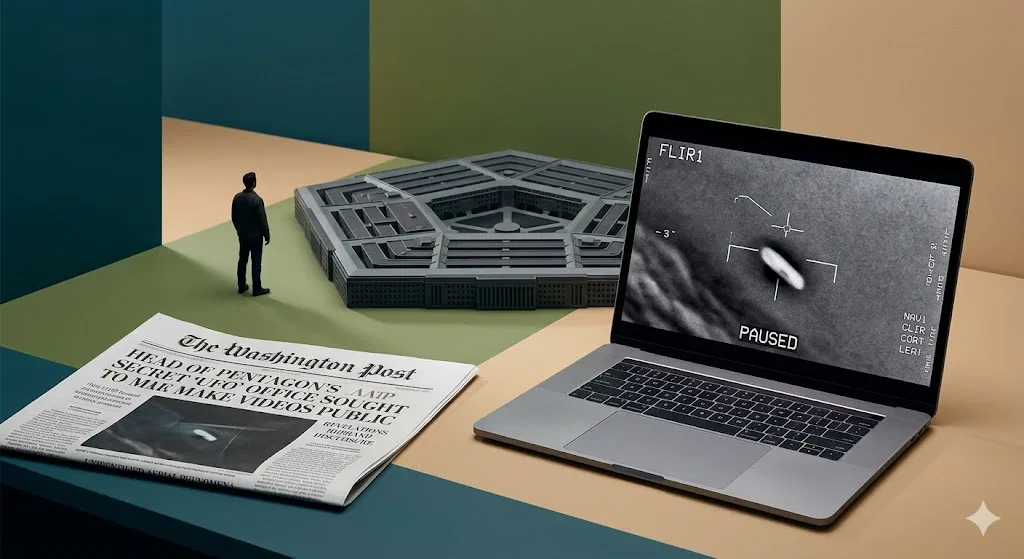
The 2017 Pentagon programme revelations changed the modern UFO disclosure movement because they made the subject legible to mainstream readers as a defence, aviation and oversight issue rather than only a belief-driven argument about aliens. In December 2017, major US reporting disclosed that the Department of Defense had funded a little-known effort, commonly described as the Advanced Aerospace Threat Identification Program, or AATIP, to examine unusual aerospace reports; the same reporting wave placed Navy cockpit videos and named former defence officials at the centre of the story. The most important effect was not proof of extraterrestrial visitation. It was a rebranding of the issue: unexplained sightings by military personnel became “unidentified aerial phenomena” tied to pilot safety, restricted airspace, intelligence collection and congressional accountability. The later official record has remained cautious, with the Pentagon saying the released Navy videos were real but still “unidentified”, and AARO’s 2024 historical review finding no empirical evidence of recovered extraterrestrial technology.[The Washington Post]washingtonpost.comThe Washington Post Head of Pentagon's secret 'UFO' office sought to makeThe Washington PostHead of Pentagon's secret 'UFO' office sought to make…December 17, 2017 — 16 Dec 2017 — Pentagon official Luis Eliz…[2U.S. Department of War]defense.govU.S. Department of WarStatement by the Department of Defense on the Release…Statement by the Department of Defense on the Release of H…
What the Pentagon Programme Reporting Revealed
The December 2017 reporting established three claims that reshaped the public conversation. First, the US government had spent public money on a once-obscure effort to study unusual aerospace reports. The Washington Post reported that the programme began in 2007, involved at least $22 million in funding, and was backed by former Senate majority leader Harry Reid, with work connected to Bigelow Aerospace in Nevada. The Pentagon said the specific funding ended in 2012 because other priorities were judged more important, while people familiar with the effort argued that some collection and analysis continued afterwards in less formal ways.[The Washington Post]washingtonpost.comThe Washington Post Head of Pentagon's secret 'UFO' office sought to makeThe Washington PostHead of Pentagon's secret 'UFO' office sought to make…December 17, 2017 — 16 Dec 2017 — Pentagon official Luis Eliz…
Second, the story linked the programme to military encounters, not just civilian sightings. The central evidence package included cockpit-camera videos, accounts from Navy aviators and claims that some incidents involved radar or other sensor data. The most famous example was the 2004 USS Nimitz encounter, later described publicly by retired Navy pilot David Fravor, who said he saw a white “Tic Tac”-shaped object off the coast between San Diego and Ensenada during a training exercise. The videos alone did not prove what the objects were, but they gave the story a military texture that older flying-saucer accounts often lacked: squadrons, carriers, sensors, restricted airspace and pilots worried about being dismissed.[The Washington Post]washingtonpost.comThe Washington Post Head of Pentagon's secret 'UFO' office sought to makeThe Washington PostHead of Pentagon's secret 'UFO' office sought to make…December 17, 2017 — 16 Dec 2017 — Pentagon official Luis Eliz…
Third, the reporting introduced Luis Elizondo and Christopher Mellon as important disclosure-era figures. Elizondo said he had run the programme and had resigned in frustration at secrecy and lack of official priority. The Washington Post reported that he had sought to clear unusual videos for public release and had framed that effort partly around pilot education and aviation safety. Mellon, a former deputy assistant secretary of defence for intelligence, helped bring the issue into elite policy and media networks. Their role mattered because the disclosure movement gained narrators with intelligence and defence credentials, not only long-standing civilian researchers.[The Washington Post]washingtonpost.comThe Washington Post Head of Pentagon's secret 'UFO' office sought to makeThe Washington PostHead of Pentagon's secret 'UFO' office sought to make…December 17, 2017 — 16 Dec 2017 — Pentagon official Luis Eliz…
The revelations also had a built-in ambiguity that still shapes debate. The public phrase AATIP became a shorthand for “the Pentagon UFO programme”, but later official and critical accounts have complicated that label. AARO’s 2024 historical report treated the relevant effort as AAWSAP/AATIP, saying it was funded through the Defense Intelligence Agency, produced exploratory papers on advanced science topics, and also became entangled with UAP and paranormal research connected to a Utah property owned by the private-sector organisation involved. AARO concluded that the programme ended in 2012 after deliverables were completed and due to government concerns about its merit and utility.[AARO]aaro.milAARO Historical Record Report VolAARO Historical Record Report Vol
That distinction matters for readers because the 2017 story was both a revelation and a reframing. It revealed that government money had gone into a programme associated with unusual aerial reports. It did not reveal a settled official finding that the objects were extraterrestrial, nor did it establish a clean, transparent programme history. The movement’s later arguments grew partly out of that gap: supporters saw confirmation that serious people inside government had been studying something real, while sceptics saw a poorly documented programme whose public image outran its evidentiary base.
Why the Vocabulary Shifted to UAP
The shift from “UFO” to “UAP” was not merely cosmetic. “UFO” had decades of cultural baggage: flying saucers, hoaxes, ridicule, tabloid headlines and conspiracy mythology. “UAP”, originally “unidentified aerial phenomena” and later often broadened to “unidentified anomalous phenomena”, allowed officials and journalists to discuss the same unresolved observations in a less loaded vocabulary. The term did not answer what the objects were; it changed the conditions under which people could talk about them.
The 2017 revelations accelerated that shift because they placed the issue inside the language of military risk. The Washington Post reported that Elizondo argued releasing videos could educate pilots and improve aviation safety. In 2019, Navy reporting guidelines were described as an attempt to formalise reports and reduce stigma, while Navy officials preferred “unidentified aerial phenomena” because the problem was framed as airspace safety and security rather than folklore.[The Washington Post]washingtonpost.comThe Washington Post Head of Pentagon's secret 'UFO' office sought to makeThe Washington PostHead of Pentagon's secret 'UFO' office sought to make…December 17, 2017 — 16 Dec 2017 — Pentagon official Luis Eliz…[The Washington Post]washingtonpost.comThe Washington Post Head of Pentagon's secret 'UFO' office sought to makeThe Washington PostHead of Pentagon's secret 'UFO' office sought to make…December 17, 2017 — 16 Dec 2017 — Pentagon official Luis Eliz…
The later official language confirmed the new frame. The Department of Defense’s 2020 release of the three historical Navy videos said the objects remained “unidentified” and described them as part of investigations into military airspace incursions by unidentified aerial phenomena. The 2021 Office of the Director of National Intelligence preliminary assessment then stated that UAP “clearly pose a safety of flight issue” and may pose a national-security challenge, especially if some represented foreign collection platforms or advanced adversary systems.[U.S. Department of War]defense.govU.S. Department of WarStatement by the Department of Defense on the Release…Statement by the Department of Defense on the Release of H…(#endnote-1 “Snippet: U.S. Department of WarStatement by the Department of Defense on the Release…Statement by the Department of Defense on the Release of H…”)
This vocabulary change altered incentives for witnesses. A pilot who reported a “UFO” risked sounding unserious; a pilot who reported an unidentified object in controlled airspace was making a safety report. That difference is central to the modern disclosure movement. It allowed advocates to argue that even if most cases eventually turned out to be drones, balloons, sensor artefacts, aircraft, atmospheric effects or misperceptions, the reporting system still needed to collect data without stigma.
It also narrowed the strongest version of the argument. The UAP frame does not require a reader to accept extraterrestrial claims. It asks whether unknown objects are entering training ranges, whether sensors are producing confusing results, whether pilots have consistent reporting channels, and whether Congress is receiving accurate information about classified programmes and defence spending. That is why the 2017 wave mattered: it moved the argument from “believe the witnesses” to “build a system that can test the reports”.
How Media Coverage Changed Political Incentives
Before 2017, a politician who pushed UFO transparency could easily be portrayed as eccentric. After the Pentagon programme stories, the same interest could be described as oversight of defence, intelligence and aviation safety. This did not remove stigma, but it gave lawmakers a more defensible public rationale: they could ask for briefings, reporting standards and classified review without endorsing alien conclusions.
The media package was unusually powerful because it combined several elements at once. There was a named Pentagon-linked programme, a modest but memorable budget figure, senior political backing from Harry Reid, Navy videos, former officials willing to speak publicly and pilots describing encounters near military operations. Vanity Fair captured the media shock by noting how improbable it had once seemed that a UFO story would land on the front page of The New York Times, while later media criticism argued that some coverage leaned too heavily into mystery and too lightly into prosaic explanations.[Vanity Fair]vanityfair.comVanity Fair“We May Not Be Alone”: Inside the Times's U.F.O. ReportVanity Fair“We May Not Be Alone”: Inside the Times's U.F.O. Report
The political effect was cumulative. By 2019, reports described Navy efforts to formalise UAP reporting and congressional interest in briefings. By 2020, the Department of Defense officially released the three Navy videos to clear up public misconceptions over whether the circulating footage was real. By 2021, ODNI submitted its preliminary UAP assessment to Congress, explicitly treating the issue as a policymaker problem involving weak data, safety risks and national-security uncertainty.[The Washington Post]washingtonpost.comThe Washington Post Head of Pentagon's secret 'UFO' office sought to makeThe Washington PostHead of Pentagon's secret 'UFO' office sought to make…December 17, 2017 — 16 Dec 2017 — Pentagon official Luis Eliz…[2U.S. Department of War]defense.govU.S. Department of WarStatement by the Department of Defense on the Release…Statement by the Department of Defense on the Release of H…
The 2017 revelations also helped disclosure advocates separate two different claims that had often been fused together. One claim was institutional: government agencies had collected UAP reports, some data remained classified, and witnesses needed safer reporting channels. The other was extraordinary: the US government possessed or had concealed non-human technology. The first claim gained substantial official traction after 2017. The second remained contested and, in official reviews, unsupported by verifiable evidence. AARO’s 2024 historical report said it found no empirical evidence that US government or private-sector programmes had recovered or reverse-engineered extraterrestrial technology, and that many modern claims appeared to involve misidentified sensitive programmes, circular reporting or unsupported allegations.[AARO]aaro.milOpen source on aaro.mil.
This split is one reason the 2017 moment remains so influential. It gave the movement a practical legislative pathway even when the most dramatic claims could not be proved publicly. Congress did not need to prove aliens to ask whether military ranges were being penetrated, whether reports were being lost because of stigma, whether classified programmes were properly notified, or whether agencies were withholding records that should be reviewed.
What the 2017 Shift Did Not Prove
The reporting wave made UFO disclosure more serious in public life, but it did not settle the core evidentiary questions. The Navy videos showed objects or apparent objects that remained unidentified in official language; they did not, by themselves, establish extraordinary propulsion, non-human origin or a complete sensor picture. The Department of Defense’s 2020 statement was careful: the videos were unclassified, real Navy videos, and the aerial phenomena in them remained “unidentified”.[U.S. Department of War]defense.govU.S. Department of WarStatement by the Department of Defense on the Release…Statement by the Department of Defense on the Release of H…(#endnote-1 “Snippet: U.S. Department of WarStatement by the Department of Defense on the Release…Statement by the Department of Defense on the Release of H…”)
The programme history is also more complicated than the simplest disclosure narrative. AARO’s later account said the AAWSAP/AATIP contract generated exploratory papers that were not thoroughly peer reviewed, reviewed many older and private cases, conducted interviews, and became entangled with paranormal research that DIA had not specifically authorised. Critics have used that history to argue that the 2017 public narrative overstated the programme’s rigour; supporters counter that official scepticism itself shows why independent oversight and declassification are needed.[AARO]aaro.milOpen source on aaro.mil.
The best reading is therefore neither dismissal nor hype. The 2017 revelations were historically significant because they changed who could talk about UAP, where the conversation happened, and what institutions had to do next. They did not prove that the US government had found alien craft. They did prove that a subject long pushed to the margins could become a mainstream national-security question when it was attached to military witnesses, official money, cockpit footage and congressional oversight.
Why This Moment Still Defines Modern Disclosure
The modern UFO disclosure movement still speaks in the grammar created by 2017: pilots, sensors, stigma, safety, classified briefings, defence contractors, special access programmes, congressional reporting and public trust. Later developments — Navy reporting procedures, ODNI assessments, NASA’s UAP study, AARO’s creation and congressional hearings — all became easier to imagine after the 2017 reporting made UAP a legitimate Washington subject. NASA’s 2023 independent study, for example, emphasised poor data quality and reporting stigma rather than sensational claims, echoing the same post-2017 shift from folklore to systems of evidence.[NASA Science]science.nasa.govScience Independent Study Team ReportScience Independent Study Team Report
The lasting change was reputational. Before 2017, UFO disclosure was often treated as a demand for the government to admit a hidden alien truth. After 2017, the stronger public argument became broader and more durable: unidentified reports in military and intelligence contexts deserve transparent handling, better data, less stigma and accountable oversight, even when the ultimate explanation is ordinary. That made the movement more politically resilient, because it no longer depended entirely on the most extraordinary interpretation being true.
The unresolved tension is that the same rebranding that made the subject respectable also created space for inflated claims. “UAP” can mean a genuine unknown, a foreign drone, a sensor problem, a balloon, a classified aircraft, an unusual atmospheric effect, or an allegation of non-human technology. The 2017 Pentagon programme revelations did not remove that ambiguity; they made it impossible for institutions to ignore.

Amazon book picks
Further Reading
Books and field guides related to The Reporting That Rebranded UFO Disclosure. Use these as the next step if you want deeper reading beyond the article.
In Plain Sight: an Investigation Into UFOs and Impossible Sci...
Examines developments that followed the 2017 reporting wave.
Skinwalkers at the Pentagon
Connected to government-funded investigations discussed after 2017.
eBay marketplace picks
Marketplace Samples
Example marketplace items related to this page. Use the search link to explore similar finds on eBay.




Endnotes
1.
Source: defense.gov
Link:https://www.defense.gov/News/Releases/release/article/2165713/statement-by-the-department-of-defense-on-the-release-of-historical-navy-videos/
Source snippet
U.S. Department of WarStatement by the Department of Defense on the Release...Statement by the Department of Defense on the Release of H...
2.
Source: aaro.mil
Title: AARO Historical Record Report Vol 1 2024
Link:https://www.aaro.mil/Portals/136/PDFs/AARO_Historical_Record_Report_Vol_1_2024.pdf
3.
Source: science.nasa.gov
Title: Science Independent Study Team Report
Link:https://science.nasa.gov/wp-content/uploads/2023/09/uap-independent-study-team-final-report.pdf
4.
Source: war.gov
Link:https://www.war.gov/UFO/
5.
Source: war.gov
Title: statement by the department of defense on the release of historical navy videos
Link:https://www.war.gov/News/Releases/Release/Article/2165713/statement-by-the-department-of-defense-on-the-release-of-historical-navy-videos/
6.
Source: war.gov
Title: dod examining unidentified anomalous phenomena
Link:https://www.war.gov/News/News-Stories/Article/Article/3965403/dod-examining-unidentified-anomalous-phenomena/
7.
Source: science.nasa.gov
Link:https://science.nasa.gov/uap/
8.
Source: nasa.gov
Title: nasa to release discuss unidentified anomalous phenomena report
Link:https://www.nasa.gov/news-release/nasa-to-release-discuss-unidentified-anomalous-phenomena-report/
9.
Source: aaro.mil
Link:https://www.aaro.mil/
10.
Source: aaro.mil
Link:https://www.aaro.mil/Portals/136/PDFs/UAP_RECORDS_RESEARCH/History_and_Origin_of_KONA_BLUE_FINAL_508.pdf
11.
Source: media.defense.gov
Title: DOPSR 2024 0263 AARO HISTORICAL RECORD REPORT VOLUME 1 2024
Link:https://media.defense.gov/2024/Mar/08/2003409233/-1/-1/0/DOPSR-2024-0263-AARO-HISTORICAL-RECORD-REPORT-VOLUME-1-2024.PDF
12.
Source: secnav.navy.mil
Title: mil UF O_Redacted.pdf
Link:https://www.secnav.navy.mil/foia/readingroom/CaseFiles/UAP%20INFO/UAP%20DOCUMENTS/UFO_Redacted.pdf
13.
Source: secnav.navy.mil
Title: mil Prelimary Assessment UAP
Link:https://www.secnav.navy.mil/foia/readingroom/CaseFiles/UAP%20INFO/Prelimary%20Assessment%20UAP.pdf
14.
Source: space.com
Title: ufos videos declassified navy release
Link:https://www.space.com/ufos-videos-declassified-navy-release.html
15.
Source: space.com
Title: ufo sightings pentagon task force
Link:https://www.space.com/ufo-sightings-pentagon-task-force.html
16.
Source: washingtonpost.com
Title: The Washington Post Head of Pentagon’s secret ‘UFO’ office sought to make
Link:https://www.washingtonpost.com/world/national-security/head-of-pentagons-secret-ufo-office-sought-to-make-evidence-public/2017/12/16/90bcb7cc-e2b2-11e7-8679-a9728984779c_story.html
Source snippet
The Washington PostHead of Pentagon's secret 'UFO' office sought to make...December 17, 2017 — 16 Dec 2017 — Pentagon official Luis Eliz...
Published: December 17, 2017
17.
Source: Wikipedia
Title: Advanced Aerospace Threat Identification Program
Link:https://en.wikipedia.org/wiki/Advanced_Aerospace_Threat_Identification_Program
18.
Source: washingtonpost.com
Title: The Washington Post Former Navy pilot describes UFO encounter studied by
Link:https://www.washingtonpost.com/news/checkpoint/wp/2017/12/18/former-navy-pilot-describes-encounter-with-ufo-studied-by-secret-pentagon-program/
19.
Source: Wikipedia
Title: Luis Elizondo
Link:https://en.wikipedia.org/wiki/Luis_Elizondo
20.
Source: washingtonpost.com
Title: how angry pilots got navy stop dismissing ufo sightings
Link:https://www.washingtonpost.com/national-security/2019/04/24/how-angry-pilots-got-navy-stop-dismissing-ufo-sightings/
21.
Source: vanityfair.com
Title: Vanity Fair“We May Not Be Alone”: Inside the Times’s U.F.O. Report
Link:https://www.vanityfair.com/news/2017/12/we-may-not-be-alone-ufo-report-times?srsltid=AfmBOoqyO8Fjd-XgvlkAURHxFxJUak5NwZUbp2rbOpKVJ3uaY05a9ItB
22.
Source: Wikipedia
Title: Advanced Aerospace Threat Identification Program
Link:https://fr.wikipedia.org/wiki/Advanced_Aerospace_Threat_Identification_Program
23.
Source: Wikipedia
Title: Christopher Mellon
Link:https://en.wikipedia.org/wiki/Christopher_Mellon
24.
Source: reddit.com
Title: office of the director of national intelligence
Link:https://www.reddit.com/r/space/comments/o7wpjg/office_of_the_director_of_national_intelligence/
25.
Source: vanityfair.com
Title: ufo report media
Link:https://www.vanityfair.com/news/2023/06/ufo-report-media?srsltid=AfmBOooLSs7N_vmilLK6hn4posQCorToI1sOGzukBaWI48YBNpHhIarX
26.
Source: animated-character-database.fandom.com
Title: Luis Elizondo
Link:https://animated-character-database.fandom.com/wiki/Luis_Elizondo
27.
Source: coffeeordie.com
Title: unidentified aerial phenomena
Link:https://www.coffeeordie.com/article/unidentified-aerial-phenomena
28.
Source: capradio.org
Link:https://www.capradio.org/news/npr/story?storyid=571446881
Additional References
29.
Source: theguardian.com
Title: The Guardian The Pentagon released its UFO videos
Link:https://www.theguardian.com/science/2026/apr/22/pentagon-released-ufo-videos-chase-aliens
Source snippet
He reveals that the alleged UFO investigation program AATIP was misunderstood, with the real program, AAWSAP, having roots in paranormal...
30.
Source: youtube.com
Title: $22 Million Spent On Pentagon UFO Research
Link:https://www.youtube.com/watch?v=F8owqkrtHe8
Source snippet
Unidentified: Inside America's UFO Investigation Promo | History...
31.
Source: youtube.com
Title: LEAKED UFO DOCUMENTS prove Pentagon AATIP UFO program real
Link:https://www.youtube.com/watch?v=K-DiGk-DiGk
Source snippet
$22 Million Spent On Pentagon UFO Research - Declassified 2017 - New York Times Story...
32.
Source: dni.gov
Link:https://www.dni.gov/index.php/newsroom/reports-publications/reports-publications-2021/3550-preliminary-assessment-unidentified-aerial-phenomena
33.
Source: govinfo.gov
Link:https://www.govinfo.gov/content/pkg/CHRG-118hhrg53022/html/CHRG-118hhrg53022.htm
34.
Source: youtube.com
Title: Unidentified: Inside America’s UFO Investigation Promo | History
Link:https://www.youtube.com/watch?v=ewnJ6okvsK0
Source snippet
Ex-UFO program chief: We may not be alone...
35.
Source: youtube.com
Title: Ex-UFO program chief: We may not be alone
Link:https://www.youtube.com/watch?v=-2b4qSoMnKE
Source snippet
Pentagon Admits Secret Program AATIP Investigated UFOs | New York Post...
36.
Source: medium.com
Link:https://medium.com/six-articles/5-the-new-architecture-tracing-the-apparatus-of-the-modern-ufo-disclosure-push-afd40ed1c381
37.
Source: solveforce.com
Link:https://solveforce.com/aawsap/
38.
Source: britannica.com
Link:https://www.britannica.com/topic/Advanced-Aviation-Threat-Identification-Program
Topic Tree