Within UAP Disclosure
When Does UFO Secrecy Stop Protecting Security?
UFO disclosure is often less about aliens than whether secrecy rules have hidden records, mistakes, or programmes from public oversight.
On this page
- What disclosure advocates mean by secrecy
- Why defence and intelligence records stay classified
- How overclassification claims can be tested
Page outline Jump by section
Introduction
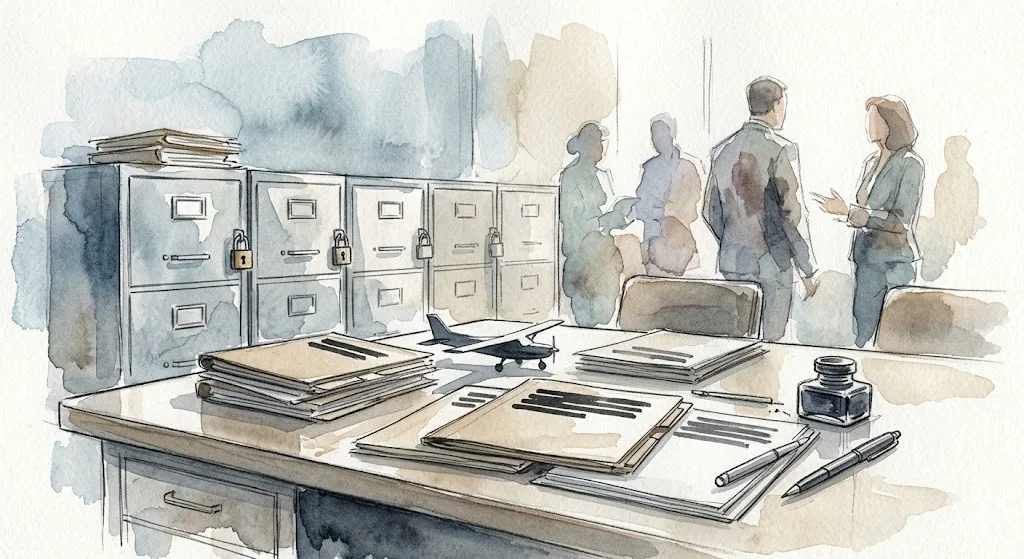
Government secrecy sits at the centre of the UFO disclosure movement because many of the strongest arguments are not, strictly speaking, claims about aliens. They are claims about records: who has them, who can see them, who decides what stays classified, and whether national security rules have been stretched so far that Congress, scientists, journalists, and the public cannot test what the government actually knows.
The hard part is that both sides of the dispute can be partly right. Defence and intelligence agencies do have legitimate reasons to protect sensor capabilities, collection methods, flight-test programmes, foreign intelligence, military sites, and witness identities. But secrecy can also hide mistakes, discourage reporting, block independent analysis, and create a vacuum where unsupported claims flourish. The most useful question is therefore not “should everything be released?” but “what mechanism can separate genuinely sensitive information from information withheld by habit, embarrassment, bureaucracy, or excessive classification?”
What disclosure advocates mean by secrecy
When UFO disclosure advocates talk about “secrecy”, they usually mean more than a locked archive or a redacted file. They are pointing to a chain of control: classification decisions, special-access compartments, contractor-held records, intelligence exemptions, poor records management, and the difficulty of proving that something exists when the relevant paper trail may itself be classified.
That is why modern UAP politics often sounds different from older flying-saucer culture. The dispute is now framed around oversight and records: whether agencies have identified all UAP-related files, whether classified programmes have been properly reported to Congress, whether whistleblowers can speak lawfully, and whether historical documents can be released without exposing current military capabilities. The National Archives now has a formal Unidentified Anomalous Phenomena Records Collection, created under the 2024 National Defense Authorization Act, and NARA’s guidance tells agencies to identify, review, organise, and prepare UAP records in their custody for disclosure and transfer.[National Archives]nationalarchives.gov.ukSource details in endnotes.
The disclosure movement’s secrecy claim has three main versions:
- The narrow claim: the government has many UAP-related records that are scattered, poorly indexed, over-redacted, or hard to obtain, even when they do not prove anything exotic.
- The oversight claim: some UAP-related information may sit inside classified defence, intelligence, or contractor channels that are difficult for ordinary congressional oversight to penetrate.
- The extraordinary claim: the state, or private contractors acting with state support, has hidden recovered non-human technology or biological evidence.
Those claims should not be treated as equally proven. Public records clearly show that governments have collected UFO and UAP reports, classified some related material, and released records slowly or unevenly. They do not, by themselves, prove the existence of non-human craft. AARO’s 2024 historical report said it found no verifiable evidence that the US government or private industry has possessed extraterrestrial technology, and the Pentagon said alleged hidden reverse-engineering programmes named by interviewees were either nonexistent, misidentified national security programmes, or defunct efforts.[U.S. Department of War]war.govdepartment of war releases unidentified anomalous phenomena files in historic tdepartment of war releases unidentified anomalous phenomena files in historic t(#endnote-3 “Endnote 3”)
The result is a distinctive disclosure problem: secrecy is both a plausible reason evidence is missing and a convenient explanation for why extraordinary claims remain unverified. A healthy disclosure process has to test secrecy claims without assuming in advance that every redaction hides a revelation.
Why defence and intelligence records stay classified
UAP records often touch systems that governments are reluctant to discuss even when the object in a report is mundane. A blurry video may reveal the resolution of an aircraft sensor. A radar track may expose coverage limits. A pilot account may identify a training route, operating altitude, response procedure, or classified platform. A database field may reveal how intelligence agencies fuse information from satellites, aircraft, ships, and signals collection.
That is the basic logic of national security classification. Executive Order 13526, the current US framework for classified national security information, states that democratic government depends on public knowledge, but it also establishes a system for classifying, safeguarding, and declassifying information whose unauthorised disclosure could damage national security.[National Archives]nationalarchives.gov.ukSource details in endnotes. In UAP cases, the sensitive fact may not be the unidentified object itself; it may be the way the object was detected.
This helps explain why official releases can be frustratingly partial. A public clip may show only a few seconds of video while withholding metadata, full sensor tracks, platform details, or classified intelligence context. From a public-interest perspective, that can look evasive. From a defence perspective, the withheld material may be the part adversaries most want.
The history of Cold War reconnaissance shows why this tension is real. Declassified CIA material on the U-2 and OXCART programmes shows that secret high-altitude aircraft generated UFO reports, and later official histories linked some mid-century sightings to classified reconnaissance activity.[CIA]cia.govOpen source on cia.gov. That example cuts both ways. It shows that secrecy can produce genuine public misidentification. It also shows that at least some “UFO cover-ups” were not about aliens, but about protecting real military and intelligence programmes.
The UK record offers a similar lesson. Britain’s Ministry of Defence collected UFO reports for decades, later transferring many files to the National Archives, and its public research guide notes that surviving records include official policy papers, parliamentary business, public correspondence, and sighting reports.[The National Archives]archives.govNational Archives Guidance to Federal Agencies on Unidentified AnomalousNational Archives Guidance to Federal Agencies on Unidentified Anomalous Project Condign, a classified UK Defence Intelligence Staff study later released after Freedom of Information pressure, became controversial not because it proved extraterrestrial visitation, but because it revealed that the subject had received more internal analytical attention than many members of the public had been led to expect.[WIRED]wired.comIt's Official: UFOs Are Just UAPsIt's Official: UFOs Are Just UAPs
This is the recurring pattern: secrecy can protect real capabilities, but it also creates a delayed shock when old records show that officials took a subject more seriously internally than they admitted publicly.
Where overclassification enters the UFO debate
Overclassification is the practice of classifying information that does not truly need protection, classifying it at too high a level, or keeping it classified after the sensitivity has passed. It is not a UFO-specific problem. It is a long-running national security governance problem that becomes especially combustible when applied to UAP.
Government oversight bodies and secrecy experts have repeatedly warned that the classification system is overloaded. The Information Security Oversight Office said in its 2017 annual report that too much classification impedes information-sharing needed for security, while too little declassification undermines public trust.[National Archives]nationalarchives.gov.ukSource details in endnotes. The Public Interest Declassification Board has argued that classification and declassification need modernisation for the digital age, because old paper-era processes cannot handle the volume of modern records.[Transforming Classification]transforming-classification.blogs.archives.govSource details in endnotes.
For UAP, overclassification has several practical effects.
First, it can make cases look more mysterious than they are. If the public receives a short video without the mundane classified context that explains it, an ordinary drone, balloon, aircraft, satellite, or sensor artefact may remain publicly “unresolved” even if analysts have stronger private leads.
Second, it can prevent outside expertise from helping. NASA’s independent UAP study argued for rigorous, evidence-based analysis and better data acquisition, but NASA also emphasised the value of transparent scientific methods and public data where possible.[NASA Science]science.nasa.govScience Independent Study Team ReportScience Independent Study Team Report If the best data remain locked inside classified systems, independent scientists cannot reproduce or challenge official conclusions.
Third, it can weaken congressional confidence. UAP whistleblower claims, including David Grusch’s 2023 testimony, gained attention largely because they were framed as allegations that information had been withheld from lawful oversight channels. Grusch’s prepared statement said he became a whistleblower after receiving reports from current and former military and intelligence personnel about alleged hidden UAP activity.[Oversight Committee]oversight.house.govOversight Committee Opening StatementOversight Committee Opening Statement The public evidence for his most extraordinary claims remains disputed, but the oversight question became politically powerful because it fits a known structural risk: highly compartmented programmes can be hard for non-specialist legislators to inspect.
Fourth, overclassification can feed conspiracy thinking even when no conspiracy exists. If agencies release denials without enough supporting detail to be independently tested, sceptical audiences may treat the absence of evidence as evidence of concealment. That is not good reasoning, but it is a predictable trust failure in a system where classification is already widely seen as excessive.
The UAP records law is a test of mechanism, not belief
The most important recent development in the secrecy dispute is not a single video or whistleblower interview. It is the attempt to turn UAP disclosure into a records-management process.
The proposed 2023 UAP Disclosure Act, introduced by Senators Chuck Schumer and Mike Rounds, was modelled in part on the JFK assassination records framework and would have created a stronger public-disclosure system, including a review board. The Senate announcement said the proposal would direct NARA to create a UAP records collection and require every government office to identify relevant records.[democrats.senate.gov]democrats.senate.govSchumer, Rounds Introduce New Legislation To DeclassifySchumer, Rounds Introduce New Legislation To Declassify The proposed text allowed postponement of public disclosure only under demanding standards, including clear and convincing evidence that release would gravely threaten military defence, intelligence operations, foreign relations, privacy, or confidential sources.[democrats.senate.gov]democrats.senate.govOpen source on senate.gov.
What passed in the 2024 defence law was narrower. The final provisions created the NARA collection and required agencies to identify, review, and transfer records, but key elements of the original proposal, such as an independent review board and eminent-domain provisions, were removed. A legal analysis in the NYU Journal of Legislation and Public Policy describes the enacted version as pared down, preserving the records collection while striking the review board, eminent domain, and controlled disclosure campaign elements.[nyujlpp.org]nyujlpp.orgJLPP 27 2 YangJLPP 27 2 Yang The conference materials likewise described the final agreement as including only the government-wide records collection, transfer, and review requirements.[Ghost Storage]storage.ghost.ioStorage NATIONAL DEFENSE AUTHORIZATION ACT FOR FISCALStorage NATIONAL DEFENSE AUTHORIZATION ACT FOR FISCAL
That compromise matters because it shows the central policy disagreement. Disclosure advocates wanted a mechanism strong enough to override ordinary agency inertia. Defence and intelligence interests were more comfortable with a process that still leaves significant review power inside the executive branch.
NARA’s implementation guidance gives the process a concrete form. Agencies must identify all UAP records in any format, make digital copies, and prepare them for transfer. Publicly releasable copies are to be made available through the National Archives Catalog, while postponed or protected records remain subject to special handling.[National Archives]nationalarchives.gov.ukSource details in endnotes. The mechanism is therefore not a promise that every file becomes public immediately. It is a forcing device: agencies must search, tag, review, and account for records that might otherwise remain invisible.
The weakness is also clear. A records collection can reveal what agencies identify and transfer; it cannot easily prove that no mislabelled, contractor-held, waived, destroyed, or improperly compartmented records exist elsewhere. That is why the secrecy dispute persists even after formal disclosure laws are passed.

Why selective releases rarely settle the argument
UAP file releases often generate public attention, but they rarely resolve the deeper secrecy dispute. A release can contain interesting historical material, videos, witness statements, or agency memoranda while still leaving readers unsure what was omitted, why it was omitted, and whether the most sensitive records were ever part of the release pipeline.
In 2026, the US government launched a public UAP release portal, with the Department of War describing a government-wide effort to find, review, identify, declassify, and release unresolved UAP-related records and historical documents.[U.S. Department of War]war.govdepartment of war releases unidentified anomalous phenomena files in historic tdepartment of war releases unidentified anomalous phenomena files in historic t(#endnote-3 “Endnote 3”) News reports described new batches of files, videos, and historical records, but also noted that the releases did not establish extraterrestrial life.[Axios]axios.comOpen source on axios.com.
This illustrates the difference between transparency and resolution. Transparency can reduce suspicion by putting more primary material in public. It can also increase debate by giving researchers new fragments without the full classified context. A video of an apparent orb, a decades-old letter, or a pilot report may be valuable evidence of government interest, but not necessarily evidence of non-human technology.
Selective releases also create a sequencing problem. Agencies often release older, less sensitive records first. That may be reasonable, but it means the public sees material that is historically interesting rather than operationally decisive. Meanwhile, the records most likely to answer present-day questions may be the hardest to release because they involve current sensors, platforms, or intelligence methods.
The practical test is not whether each release produces a dramatic answer. It is whether each release improves traceability. Can researchers see which agency held the record? Is the date clear? Are redactions justified? Is there enough metadata to understand the case? Are duplicate versions reconciled? Can Congress audit what remains withheld? These questions are less exciting than “what was the object?”, but they are the questions that determine whether disclosure becomes accountable rather than theatrical.
How overclassification claims can be tested
A serious secrecy critique needs methods that can distinguish “withheld for valid reasons” from “withheld because the system defaults to secrecy”. UAP disclosure debates often skip this middle layer, jumping from total trust to total suspicion. Better tests are available.
Follow the record, not just the claim
The first test is documentary. A claim becomes stronger when it identifies agencies, dates, programmes, budget lines, classification channels, contractors, record series, or witnesses who can be lawfully interviewed by inspectors general or Congress. A claim remains weak when it depends only on unnamed sources and cannot be mapped onto auditable records.
This is why the NARA UAP collection matters even if it does not prove extraordinary claims. It creates a public and institutional place where records can be transferred, described, compared, and periodically updated.[National Archives]nationalarchives.gov.ukSource details in endnotes. It also creates a baseline against which omissions can be challenged.
Separate the object from the collection method
A UAP case may involve two different secrets: the phenomenon and the sensor. The object might be a balloon, drone, aircraft, atmospheric effect, or something unresolved. The method used to detect it might still be highly classified. A credible disclosure system should release as much as possible about the case while protecting genuinely sensitive collection details.
That could mean publishing downgraded case summaries, time windows, general locations, confidence levels, and analytic reasoning while withholding exact sensor parameters. It could also mean allowing cleared independent reviewers to inspect fuller data and publish unclassified findings.
Demand reasons for continued secrecy
The strongest disclosure reforms do not simply say “release everything”. They require agencies to justify continued withholding. The proposed UAP Disclosure Act used a “clear and convincing evidence” standard for postponement, tied to specific harms such as military defence, intelligence operations, foreign relations, privacy, and confidential sources.[democrats.senate.gov]democrats.senate.govSchumer, Rounds Introduce New Legislation To DeclassifySchumer, Rounds Introduce New Legislation To Declassify The enacted framework is less forceful, but the same principle remains important: secrecy should be argued record by record, not presumed indefinitely.
Use cleared oversight without making it the final answer
Some information cannot be responsibly released to the public in raw form. But that does not mean it should be visible only to the originating agency. Inspectors general, intelligence committees, defence committees, and properly cleared independent review mechanisms can test claims that the public cannot test directly.
This is especially important for allegations involving special-access programmes or contractors. AARO said it partnered with officials responsible for controlled and special-access programme oversight during its historical review.[Wikisource]en.wikisource.orgSection 1Section 1 Critics may still question whether that access was complete, but the correct remedy is more auditable oversight, not a leap from scepticism to certainty.
Track what changes after disclosure
A useful release should allow correction. If a once-classified case becomes explainable after metadata is released, that should reduce the unresolved pile. If a case remains unexplained even after sufficient data are available, it becomes more worthy of scientific attention. If a release shows that officials previously gave misleading public accounts, that should be acknowledged as a governance failure even if the underlying object was mundane.
This is where secrecy reform and UAP science overlap. Better records do not just satisfy curiosity; they improve the quality of the evidence base.
The risk of too much secrecy and too much certainty
The secrecy dispute has two opposite failure modes.
The first is official overconfidence. Agencies can damage trust by dismissing public concern while withholding the very material that would allow outsiders to evaluate the dismissal. AARO’s negative findings on extraterrestrial technology are significant, but they do not eliminate every concern about records management, witness reporting, classification culture, or congressional access.[U.S. Department of War]war.govdepartment of war releases unidentified anomalous phenomena files in historic tdepartment of war releases unidentified anomalous phenomena files in historic t(#endnote-3 “Endnote 3”)
The second is disclosure overreach. Some advocates treat classification itself as confirmation that extraordinary claims are true. That is not justified. Classified material may hide advanced US aircraft, foreign drones, sensor weaknesses, nuclear-security procedures, intelligence methods, embarrassing mistakes, or unresolved data too poor to analyse. None of those possibilities requires non-human technology.
The best critique is therefore disciplined rather than sensational. It accepts that national security secrecy is sometimes necessary, but insists that necessity must be demonstrated. It recognises that overclassification is a real and well-documented governance problem, but does not use that fact to validate every UAP claim. It asks for mechanisms that can produce public trust even when full public release is impossible.
What better disclosure would look like
A stronger UAP secrecy regime would not mean dumping every raw file onto the internet. It would mean building a system in which withholding is narrower, review is more independent, and released records are useful enough to be analysed.
The key features would be:
- A complete records map: agencies should identify UAP-related holdings across operational, intelligence, historical, contractor, and archived systems.
- Standard case summaries: public releases should include dates, broad locations, sensor types, analytic confidence, and known explanations where possible.
- Redaction discipline: agencies should explain redactions by harm category rather than relying on vague national security language.
- Independent review paths: disputed withholdings should be reviewable by bodies with clearance, technical competence, and independence from the originating office.
- Whistleblower-safe channels: witnesses should be able to report classified concerns lawfully without being forced into public leaking or media spectacle.
- Scientific usability: when cases remain unresolved, released data should be structured enough for outside experts to assess whether the case is truly anomalous or merely under-documented.
This approach would not satisfy everyone. Some believers would see any continued secrecy as proof of concealment. Some officials would see any wider disclosure as operationally risky. But it would move the debate away from a sterile clash between “trust us” and “they are hiding everything”.
The most defensible position is that UFO secrecy should stop protecting information when the security harm is speculative, outdated, bureaucratic, or merely embarrassing. It should continue protecting narrowly defined capabilities, sources, methods, and personal safety where the harm is concrete. The disclosure movement’s strongest contribution is not proving what UAP are. It is forcing governments to explain, with more precision than before, why the public still cannot see what they already paid to collect.
eBay marketplace picks
Marketplace Samples
Example marketplace items related to this page. Use the search link to explore similar finds on eBay.




Endnotes
1.
Source: archives.gov
Title: National Archives Guidance to Federal Agencies on Unidentified Anomalous
Link:https://www.archives.gov/records-mgmt/uap-guidance
2.
Source: archives.gov
Link:https://www.archives.gov/research/topics/uaps/rg-615
3.
Source: media.defense.gov
Title: DOPSR 2024 0263 AARO HISTORICAL RECORD REPORT VOLUME 1 2024
Link:https://media.defense.gov/2024/Mar/08/2003409233/-1/-1/0/DOPSR-2024-0263-AARO-HISTORICAL-RECORD-REPORT-VOLUME-1-2024.PDF
4.
Source: war.gov
Title: statement by pentagon press secretary maj gen pat ryder on the historical recor
Link:https://www.war.gov/News/Releases/Release/Article/3700894/statement-by-pentagon-press-secretary-maj-gen-pat-ryder-on-the-historical-recor/
5.
Source: archives.gov
Title: cnsi eo
Link:https://www.archives.gov/isoo/policy-documents/cnsi-eo.html
6.
Source: cia.gov
Link:https://www.cia.gov/readingroom/docs/CIA-RDP80B01676R004000110001-7.pdf
7.
Source: nationalarchives.gov.uk
Link:https://www.nationalarchives.gov.uk/help-with-your-research/research-guides/ufos/
8.
Source: wired.com
Title: It’s Official: UFOs Are Just UAPs
Link:https://www.wired.com/2006/05/its-official-ufos-are-just-uaps
9.
Source: archives.gov
Title: 2017 annual report
Link:https://www.archives.gov/files/isoo/reports/2017-annual-report.pdf
10.
Source: transforming-classification.blogs.archives.gov
Link:https://transforming-classification.blogs.archives.gov/2020/06/01/the-public-interest-declassification-board-provides-its-report-to-the-president-recommending-the-use-of-automation-federated-enterprise-level-approach-to-classification-and-declass/
11.
Source: science.nasa.gov
Title: Science Independent Study Team Report
Link:https://science.nasa.gov/wp-content/uploads/2023/09/uap-independent-study-team-final-report.pdf
12.
Source: axios.com
Link:https://www.axios.com/2023/09/14/nasa-uap-report-release
13.
Source: democrats.senate.gov
Title: Schumer, Rounds Introduce New Legislation To Declassify
Link:https://www.democrats.senate.gov/newsroom/press-releases/schumer-rounds-introduce-new-legislation-to-declassify-government-records-related-to-unidentified-anomalous-phenomena-and-ufos_modeled-after-jfk-assassination-records-collection-act–as-an-amendment-to-ndaa
14.
Source: democrats.senate.gov
Link:https://www.democrats.senate.gov/imo/media/doc/uap_amendment.pdf
15.
Source: nyujlpp.org
Title: JLPP 27 2 Yang
Link:https://nyujlpp.org/wp-content/uploads/2025/03/JLPP-27-2-Yang.pdf
16.
Source: storage.ghost.io
Title: Storage NATIONAL DEFENSE AUTHORIZATION ACT FOR FISCAL
Link:https://storage.ghost.io/c/c0/be/c0be35e5-1c72-42e1-af60-00793bc5b49d/content/files/2024/07/UAP-pages-only–final–from-NDAA–HR-2670–and-Joint-Explanatory-Statement-12-6-23.pdf
17.
Source: archives.gov
Link:https://www.archives.gov/research/topics/uaps/faqs
18.
Source: war.gov
Link:https://www.war.gov/UFO/
19.
Source: axios.com
Link:https://www.axios.com/2026/06/12/ufo-white-house-records
Source snippet
The newly released materials include decades-old documents, such as a 1949 letter from then-FBI Director J. Edgar Hoover regarding a citi...
20.
Source: en.wikisource.org
Title: Section 1
Link:https://en.wikisource.org/wiki/Report_on_the_Historical_Record_of_U.S._Government_Involvement_with_Unidentified_Anomalous_Phenomena/Volume_1/Section_1
21.
Source: archives.gov
Link:https://www.archives.gov/research/topics/uaps
22.
Source: archives.gov
Link:https://www.archives.gov/research/topics/uaps/photographs
23.
Source: archives.gov
Link:https://www.archives.gov/files/declassification/iscap/pdf/2014-004-doc01.pdf
24.
Source: archives.gov
Title: Project [BLUE BOOK]({{ ‘blue-book/’ | relative_url }})
Link:https://www.archives.gov/research/military/air-force/ufos
25.
Source: cia.gov
Link:https://www.cia.gov/readingroom/document/cia-rdp89g00643r001100020015-7
26.
Source: cia.gov
Title: ufos fact or fiction
Link:https://www.cia.gov/readingroom/collection/ufos-fact-or-fiction
27.
Source: cia.gov
Link:https://www.cia.gov/readingroom/docs/DOC_0000192682.pdf
28.
Source: gillibrand.senate.gov
Title: gillibrand statement on release of uap files
Link:https://www.gillibrand.senate.gov/news/press/release/gillibrand-statement-on-release-of-uap-files/
29.
Source: hsgac.senate.gov
Title: Testimony Goitein 2023 03 23 REVISED
Link:https://www.hsgac.senate.gov/wp-content/uploads/Testimony-Goitein-2023-03-23-REVISED.pdf
30.
Source: cdn.nationalarchives.gov.uk
Link:https://cdn.nationalarchives.gov.uk/documents/the-ufo-files-extract.pdf
31.
Source: storage.ghost.io
Title: io Unidentified Anomalous Phenomena Disclosure
Link:https://storage.ghost.io/c/c0/be/c0be35e5-1c72-42e1-af60-00793bc5b49d/content/files/2024/07/Pentagon-Nov-2023-proposed-revisions-to-UAPDA.pdf
32.
Source: archive.org
Title: condign vol 2 1 258
Link:https://archive.org/details/condign-vol
33.
Source: war.gov
Title: department of war releases unidentified anomalous phenomena files in historic t
Link:https://www.war.gov/News/Releases/Release/Article/4480582/department-of-war-releases-unidentified-anomalous-phenomena-files-in-historic-t/
34.
Source: war.gov
Title: media engagement with acting aaro director tim phillips on the historical recor
Link:https://www.war.gov/News/Transcripts/Transcript/Article/3702219/media-engagement-with-acting-aaro-director-tim-phillips-on-the-historical-recor/
35.
Source: war.gov
Title: department of defense releases the annual report on unidentified anomalous phen
Link:https://www.war.gov/News/Releases/Release/Article/3964824/department-of-defense-releases-the-annual-report-on-unidentified-anomalous-phen/
36.
Source: war.gov
Link:https://www.war.gov/medialink/ufo/061226/release_03/documents/CIA-UAP-002_Scientific-Advisory-Panel-on-Unidentified-Flying-Objects_Report_1952-1953.pdf
37.
Source: fam.state.gov
Link:https://fam.state.gov/fam/05fam/05fam0480.html
38.
Source: aaro.mil
Title: UAP Records
Link:https://www.aaro.mil/UAP-Records/
39.
Source: aaro.mil
Link:https://www.aaro.mil/UAP-Cases/Official-UAP-Imagery/
40.
Source: aaro.mil
Link:https://www.aaro.mil/
41.
Source: aaro.mil
Title: AARO Historical Record Report Vol 1 2024
Link:https://www.aaro.mil/Portals/136/PDFs/AARO_Historical_Record_Report_Vol_1_2024.pdf
42.
Source: science.nasa.gov
Link:https://science.nasa.gov/uap/
43.
Source: disclosure.org
Link:https://disclosure.org/news/nsa-top-secret-umbra-uap-foia-release
44.
Source: freedom.press
Title: new [bipartisan]({{ ‘bipartisan/’ | relative_url }}) senate bill seeks to reduce overclassification
Link:https://freedom.press/the-classifieds/new-bipartisan-senate-bill-seeks-to-reduce-overclassification/
45.
Source: en.wikisource.org
Title: Index:AARO Historical Record Report Volume 1 2024
Link:https://en.wikisource.org/wiki/Index%3AAARO_Historical_Record_Report_Volume_1_2024.pdf
46.
Source: en.wikisource.org
Title: Volume 1
Link:https://en.wikisource.org/wiki/Report_on_the_Historical_Record_of_U.S._Government_Involvement_with_Unidentified_Anomalous_Phenomena/Volume_1
47.
Source: oversight.house.gov
Title: Oversight Committee Opening Statement
Link:https://oversight.house.gov/wp-content/uploads/2023/07/Dave_G_HOC_Speech_FINAL_For_Trans.pdf
48.
Source: Wikipedia
Title: Project Condign
Link:https://en.wikipedia.org/wiki/Project_Condign
49.
Source: nextgov.com
Title: national archives tees new rules ufo records
Link:https://www.nextgov.com/digital-government/2024/02/national-archives-tees-new-rules-ufo-records/393982/
Additional References
50.
Source: youtube.com
Link:https://www.youtube.com/watch?v=V7Cq-jlQwo8
Source snippet
From 2025: Notable UFO testimony at House hearing on government transparency...
51.
Source: youtube.com
Title: LIVE: Lawmakers, whistleblower call for release of UFO records
Link:https://www.youtube.com/watch?v=RN-Purf4UXE
Source snippet
'Reality should not be classified': Lawmakers, advocates make push for UFO disclosure...
52.
Source: youtube.com
Link:https://www.youtube.com/watch?v=ZPtX8isVsQo
Source snippet
Lawmakers demand disclosure of UAP information...
53.
Source: govinfo.gov
Link:https://www.govinfo.gov/content/pkg/CHRG-114hhrg26177/html/CHRG-114hhrg26177.htm
54.
Source: govinfo.gov
Link:https://www.govinfo.gov/content/pkg/CHRG-108hhrg98291/html/CHRG-108hhrg98291.htm
55.
Source: oversight.house.gov
Link:https://oversight.house.gov/release/hearing-wrap-up-lack-of-transparency-and-reporting-mechanisms-have-eroded-public-trust-on-governments-handling-of-uap-encounters%EF%BF%BC/
56.
Source: federalregister.gov
Link:https://www.federalregister.gov/documents/2020/06/10/2020-10248/classification-de-classification-and-public-availability-of-national-security-information
57.
Source: youtube.com
Title: Lawmakers demand disclosure of UAP information
Link:https://www.youtube.com/watch?v=5Py0BhmvIuI
Source snippet
Watch: House committee hears testimony from witnesses on UFOs | NBC News...
58.
Source: academia.edu
Link:https://www.academia.edu/77211053/The_British_Mod_Study_Project_Condign
59.
Source: facebook.com
Link:https://www.facebook.com/NTDLifeOfficial/posts/3rd-batch-of-declassified-ufo-files-released/1347116940937121/
Topic Tree