Within UAP Disclosure
Why UAP Became a National Security Issue
National security framing lets officials discuss UAP without endorsing alien claims, focusing instead on airspace and sensors.
On this page
- How security language changed the debate
- Why restricted airspace matters
- Where security framing can overreach
Page outline Jump by section
Introduction
National security framing is the reason UAP reports became discussable in official Washington without requiring officials to endorse claims about aliens. Instead of asking whether a sighting proves extraterrestrial visitation, the security frame asks narrower questions: was something in controlled or sensitive airspace, did pilots have enough information to avoid it, did sensors capture reliable data, and could an unidentified object be a drone, balloon, foreign surveillance platform, classified aircraft, sensor artefact, or natural phenomenon?
That change mattered for the UFO disclosure movement because it gave lawmakers, military witnesses, journalists, and sceptical analysts a shared language. A UAP could be treated as an airspace, aviation safety, intelligence, and oversight problem even when its origin remained unknown. The tradeoff is that security language can also inflate weak evidence, pull ordinary misidentifications into classified channels, and make “unknown” sound more threatening than the data justify.
How security language changed the debate
The modern official frame was set clearly in the 2021 Office of the Director of National Intelligence preliminary assessment. The report did not say UAP were alien craft. It said limited, inconsistent reporting made firm conclusions difficult; likely explanations could include airborne clutter, natural atmospheric phenomena, US government or industry programmes, foreign adversary systems, and an “other” category. Its pivotal sentence was that UAP “clearly pose a safety of flight issue” and “may pose a challenge to U.S. national security” if they represent foreign collection platforms or breakthrough adversary technology.[National Intelligence Office]dni.govNational Intelligence Office
That wording changed the public argument. The older UFO debate often forced people into a cultural binary: believer or debunker. The UAP security frame created a third position: a person could say, “I do not know what this was, but unidentified objects near aircraft, military exercises, or sensitive sites deserve proper reporting and analysis.” This made the subject easier for pilots, intelligence officials, and members of Congress to discuss without seeming to endorse the most extraordinary interpretation.
It also shifted the burden of proof. Under an extraterrestrial frame, the central question is whether a case proves a non-human origin. Under a national security frame, the first question is whether the object was identified well enough for operational purposes. A balloon, drone, aircraft, satellite flare, sensor artefact, or adversary platform may all be “not alien”, but they are not equally irrelevant. A drone in the wrong airspace, a misread sensor return during a training exercise, and a real but unidentified aircraft near a military range all matter for different reasons.
This is why official UAP language often sounds cautious and bureaucratic. It is designed to keep several possibilities open while avoiding a leap from “unidentified” to “extraordinary”. A 2024 academic analysis described this as a shift from dismissal towards “strategic ambiguity” or partial securitisation: UAP are framed as potential security concerns serious enough to investigate, but not as confirmed existential threats requiring panic or a single settled explanation.[Sage Journals]journals.sagepub.comSage JournalsCasting Ambiguity: Securitization of Unidentified Anomalous Phenomena in the United States - Ghaleb Krame, Vlado Vivoda, Tam…
Why restricted airspace matters
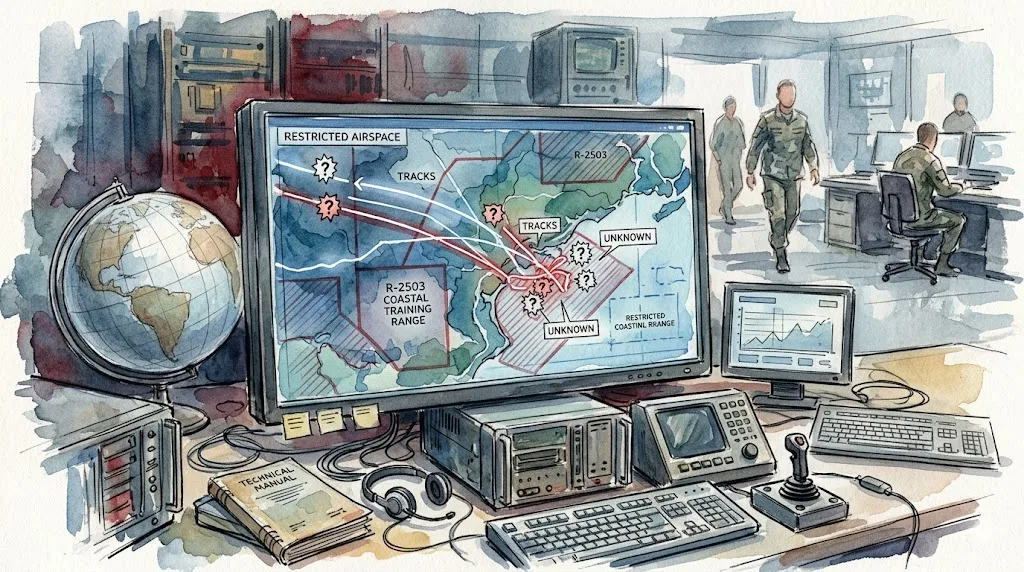
Restricted or military-controlled airspace is central to the national security framing because it changes what a sighting can mean. If a civilian sees a light in the sky from a garden, the most likely issues are identification, context, and reporting quality. If a military aircrew or sensor system records an unidentified object during a training mission or near a sensitive installation, the same ambiguity can become an operational question: what was there, who controlled it, and did it affect flight safety or mission security?
AARO’s 2023 report said most reports still reflected a bias towards restricted military airspace, partly because military personnel and sensors are concentrated there. That point cuts both ways. It supports taking such reports seriously, because they involve trained observers and defence systems. But it also warns against assuming hotspots prove exotic activity: the places with more military sensors, exercises, and reporting channels will naturally produce more official reports.[AARO]aaro.milFiscal Year 2023 Consolidated Annual Report on…November 29, 2023 — Most reports still reflect a bias towards restricted military a…
The 2024 AARO report reinforced this collection-bias problem. It said AARO had 1,652 total reports as of October 2024 and received 757 reports for the May 2023 to June 2024 reporting period, with 708 in the air domain and 49 in the space domain. It also noted that all the space-domain reports came from pilots or ground observers, not space-based sensors, and that many cases lacked enough data for full analysis.[U.S. Department of War]media.defense.govFY24 CONSOLIDATED ANNUAL REPORT ON UAP 508U.S. Department of WarFiscal Year 2024 Consolidated Annual Report on Unidentified Anomalous Phenomena…
The most useful lesson is not simply “more reports means more UAP”. It is that reports follow sensors, habits, incentives, and reporting rules. AARO’s 2024 report said 81 reports came from US military operating areas, while US military assets in the East Asian seas provided 100 reports; AARO resolved 40 of those East Asian cases as balloons or unmanned aerial systems and placed the remaining cases in an archive because there was not enough information for analysis.[U.S. Department of War]media.defense.govFY24 CONSOLIDATED ANNUAL REPORT ON UAP 508U.S. Department of WarFiscal Year 2024 Consolidated Annual Report on Unidentified Anomalous Phenomena…
Independent research points in the same direction. RAND analysed 101,151 public UAP reports from 1998 to 2022 and found that reports were more likely within 30 kilometres of military operations areas. RAND did not treat that as proof of exotic craft; it recommended public outreach near military operating areas, better notices about authorised activity where appropriate, and a stronger reporting system to reduce hoaxes and misidentifications.[RAND Corporation]rand.orgSource details in endnotes.
The mechanism: from sighting to security issue
National security framing works through a practical chain rather than a single dramatic claim.
First, an object or sensor return is not immediately identified. That may be because it is genuinely unusual, but it may also be because the observer lacks distance, speed, altitude, metadata, or corroborating sensor data. The 2021 ODNI assessment warned that some reported unusual characteristics could result from sensor errors, spoofing, or observer misperception, which is why further rigorous analysis is needed before drawing conclusions.[National Intelligence Office]dni.govNational Intelligence Office
Second, the location and context raise the stakes. An unidentified object near a training range, carrier group, nuclear-related site, border area, or busy flight corridor may matter even if the eventual explanation is ordinary. The security question is not “is this alien?” but “could this interfere with aviation, reveal a surveillance gap, indicate adversary collection, or expose weaknesses in how data are fused?”
Third, the report enters an institutional system. That system may involve military operational channels, FAA logs, intelligence partners, and AARO analysis. In 2024, AARO said its reports came through US military service operational channels or civil and commercial aviation reporting logs provided by the FAA, and that it had not received UAP reports collected through national GEOINT, SIGINT, or MASINT platforms during that reporting period. That is important because it shows both a growing reporting apparatus and clear limits in the available evidence.[U.S. Department of War]media.defense.govFY24 CONSOLIDATED ANNUAL REPORT ON UAP 508U.S. Department of WarFiscal Year 2024 Consolidated Annual Report on Unidentified Anomalous Phenomena…
Finally, the case is either resolved, held for further analysis, or archived until more data appear. In the 2024 reporting period, AARO said it resolved 118 cases to prosaic objects such as balloons, birds, and unmanned aerial systems, while many others remained unresolved because they lacked sufficient data. It also said it had found no evidence to date of extraterrestrial beings, activity, or technology, and that none of the resolved cases substantiated advanced foreign adversarial capabilities or breakthrough aerospace technologies.[U.S. Department of War]media.defense.govFY24 CONSOLIDATED ANNUAL REPORT ON UAP 508U.S. Department of WarFiscal Year 2024 Consolidated Annual Report on Unidentified Anomalous Phenomena…
This mechanism explains why the same report can sound both serious and deflationary. UAP are serious because unidentified things in controlled airspace are a safety and intelligence concern. Many cases are deflationary because better data often turns them into balloons, drones, aircraft, satellites, birds, or sensor artefacts.

Sensors made the issue credible, but also confusing
The national security frame depends heavily on sensors: radar, infrared video, electro-optical systems, pilot observations, air traffic data, and sometimes intelligence databases. Sensor involvement gives many UAP cases more credibility than casual sightings, but it does not automatically make them more mysterious. Sensors can mislead, especially when images are low-resolution, compressed, missing metadata, or captured by equipment designed for targeting or navigation rather than scientific measurement.
NASA’s 2023 independent study made this point forcefully. It said UAP analysis is hampered by poor sensor calibration, lack of multiple measurements, lack of sensor metadata, and lack of baseline data. It recommended multiple well-calibrated sensors, better curation, and NASA support for a broader whole-of-government framework.[NASA Science]science.nasa.govSource details in endnotes.
This matters because many public debates treat sensor imagery as if it speaks for itself. It rarely does. A small object can appear fast if its distance is unknown. A camera artefact can look like an unusual wake. A satellite constellation can appear as strange lights to a pilot without enough contextual data. NASA’s report noted that a South Asian object seen in MQ-9 footage was later assessed by AARO as likely a commercial aircraft, with the apparent wake probably caused by video compression.[NASA Science]science.nasa.govSource details in endnotes.
The best version of the security frame therefore pushes UAP inquiry towards better measurement rather than louder speculation. NASA argued that artificial intelligence and machine learning may help find rare events in large datasets, but only when the data are well characterised and gathered to strong standards. In plain terms, better algorithms cannot rescue bad inputs.[NASA Science]science.nasa.govSource details in endnotes.
Why the framing helped the disclosure movement
For the UFO disclosure movement, national security language created political traction. It allowed advocates to argue that the government should release more records, protect witnesses, improve reporting channels, and brief Congress without first proving the most extraordinary claims. “Airspace safety” and “intelligence oversight” are easier for institutions to act on than “prove or disprove alien visitation”.
Congressional hearings show this shift. The House Oversight subcommittee’s 2023 hearing was formally framed around national security, public safety, and government transparency, and its announcement said the hearing would examine firsthand accounts and possible threats to US national security.[house]oversight.house.govSource details in endnotes.
That frame also made testimony from military pilots more legible to mainstream audiences. The most persuasive public point was not necessarily that every reported manoeuvre was impossible; it was that pilots described encountering things they could not identify, often in training contexts, and that stigma or unclear reporting pathways could suppress useful safety data. NASA’s study likewise said stigma around UAP reporting likely causes data loss and that NASA’s public trust could help normalise rigorous reporting.[NASA Science]science.nasa.govSource details in endnotes.
The movement gained from this because it no longer had to rest entirely on spectacular claims. Even sceptics could support better declassification rules, safer pilot reporting, and improved sensor-data standards. This broadened the coalition: believers, agnostics, aviation-safety advocates, civil-liberties campaigners, and oversight-minded lawmakers could all back some form of UAP transparency for different reasons.

Where security framing can overreach
The same frame that legitimised UAP discussion can also distort it. “National security” is a powerful phrase. It can make weak evidence sound urgent, justify secrecy, and allow unresolved cases to accumulate an aura they have not earned.
One risk is threat inflation. A case that lacks enough data may be genuinely unresolved, but “unresolved” does not mean “advanced technology”. AARO’s 2024 report placed 444 cases in an active archive because they lacked sufficient data for analysis, while identifying many closed or closure-ready cases as balloons, birds, unmanned aerial systems, satellites, or aircraft. Treating every unresolved case as a hidden breakthrough would reverse the logic of investigation.[U.S. Department of War]media.defense.govFY24 CONSOLIDATED ANNUAL REPORT ON UAP 508U.S. Department of WarFiscal Year 2024 Consolidated Annual Report on Unidentified Anomalous Phenomena…
Another risk is classification drag. If UAP are discussed mainly through defence and intelligence channels, the public may receive conclusions without the underlying sensor data, methods, or metadata needed to evaluate them. That can fuel suspicion among disclosure advocates while also frustrating scientists who need reproducible evidence. NASA’s emphasis on transparent reporting, curated data, and open scientific standards was partly a response to this problem.[NASA Science]science.nasa.govSource details in endnotes.
A third risk is that national security language can blur different problems together. A hobby drone near a base, a commercial aircraft misidentified by a sensor, a balloon at altitude, a satellite flare, a foreign surveillance platform, and a genuinely unexplained event all belong in different explanatory buckets. The 2021 ODNI report’s five-category approach was valuable because it resisted a single grand explanation and treated UAP as a mixed set of cases likely requiring different answers.[National Intelligence Office]dni.govNational Intelligence Office
The strongest use of the security frame is therefore disciplined, not dramatic. It treats unidentified objects as worth investigating because airspace is crowded, military areas are sensitive, and sensor systems are imperfect. It does not treat every mystery as evidence of a cover-up, every anomaly as a threat, or every official silence as proof of extraordinary knowledge.
What this means for understanding UAP disclosure
National security framing turned UAP from a culture-war topic into a governance problem. It gave officials a way to say that unexplained reports matter without saying they prove alien technology. It also gave the disclosure movement a more durable argument: even if most cases are mundane, the public still has an interest in competent reporting, accountable classification, aviation safety, and honest communication about what is known and unknown.
The key distinction is between mystery and evidence. A national security system can legitimately investigate mysteries because unknown objects in sensitive airspace may matter. But public confidence depends on not overselling those mysteries. The most credible UAP work now sits in the gap between two errors: dismissing reports too quickly because UFOs carry stigma, and inflating ambiguous reports because national security language makes them sound automatically ominous.
That is why the security frame remains central to the disclosure movement. It is the bridge between extraordinary public interest and ordinary institutional responsibility: identify what can be identified, protect pilots who report hazards, improve sensors and metadata, brief lawmakers where secrecy is justified, release what can safely be released, and keep “unknown” separate from “proved”.
Amazon book picks
Further Reading
Books and field guides related to Why UAP Became a National Security Issue. Use these as the next step if you want deeper reading beyond the article.
The Pentagon's Brain
Explains how intelligence and defense institutions assess threats.
The Report on Unidentified Flying Objects
Shows historical treatment of unidentified aerial reports as security issues.
eBay marketplace picks
Marketplace Samples
Example marketplace items related to this page. Use the search link to explore similar finds on eBay.




Endnotes
1.
Source: dni.gov
Title: National Intelligence Office
Link:https://www.dni.gov/files/ODNI/documents/assessments/Prelimary-Assessment-UAP-20210625.pdf
2.
Source: aaro.mil
Link:https://www.aaro.mil/Portals/136/PDFs/UNCLASSIFIED-FY23_Consolidated_Annual_Report_on_UAP-Oct_25_2023_1236.pdf
Source snippet
Fiscal Year 2023 Consolidated Annual Report on...November 29, 2023 — Most reports still reflect a bias towards restricted military a...
Published: November 29, 2023
3.
Source: rand.org
Link:https://www.rand.org/pubs/research_reports/RRA2475-1.html
4.
Source: science.nasa.gov
Link:https://science.nasa.gov/wp-content/uploads/2023/09/uap-independent-study-team-final-report.pdf
5.
Source: oversight.house.gov
Link:https://oversight.house.gov/release/national-security-subcommittee-to-hold-hearing-on-unidentified-anomalous-phenomena%EF%BF%BC/
6.
Source: aaro.mil
Link:https://www.aaro.mil/
7.
Source: aaro.mil
Title: Congressional Press Products
Link:https://www.aaro.mil/Congressional-Press-Products/
8.
Source: aaro.mil
Link:https://www.aaro.mil/Submit-A-Report/
9.
Source: aaro.mil
Link:https://www.aaro.mil/UAP-Cases/Official-UAP-Imagery/
10.
Source: nasa.gov
Link:https://www.nasa.gov/
11.
Source: science.nasa.gov
Link:https://science.nasa.gov/uap/
12.
Source: science.nasa.gov
Link:https://science.nasa.gov/uap/faqs/
13.
Source: war.gov
Title: department of defense releases the annual report on unidentified anomalous phen
Link:https://www.war.gov/News/Releases/Release/Article/3964824/department-of-defense-releases-the-annual-report-on-unidentified-anomalous-phen/
14.
Source: war.gov
Title: dod examining unidentified anomalous phenomena
Link:https://www.war.gov/News/News-Stories/Article/Article/3965403/dod-examining-unidentified-anomalous-phenomena/
15.
Source: space.com
Title: nasa ufo uap study team first results revealed
Link:https://www.space.com/nasa-ufo-uap-study-team-first-results-revealed
16.
Source: space.com
Link:https://www.space.com/space-exploration/uap-witnesses-criticize-pentagon-ufo-office-in-congressional-hearing-for-using-science-and-coming-up-with-answers
17.
Source: journals.sagepub.com
Link:https://journals.sagepub.com/doi/10.1177/03043754241256845
Source snippet
Sage JournalsCasting Ambiguity: Securitization of Unidentified Anomalous Phenomena in the United States - Ghaleb Krame, Vlado Vivoda, Tam...
18.
Source: [media]({{ ‘media/’ | relative_url }}). defense.gov
Title: FY24 CONSOLIDATED ANNUAL REPORT ON UAP 508
Link:https://media.defense.gov/2024/Nov/14/2003583603/-1/-1/0/FY24-CONSOLIDATED-ANNUAL-REPORT-ON-UAP-508.PDF
Source snippet
U.S. Department of WarFiscal Year 2024 Consolidated Annual Report on Unidentified Anomalous Phenomena...
19.
Source: read-me.org
Title: fiscal year 2024 consolidated annual report on unidentified anomalous phenomena
Link:https://read-me.org/more-social-sciences/2024/12/21/fiscal-year-2024-consolidated-annual-report-on-unidentified-anomalous-phenomena
20.
Source: en.wikisource.org
Title: UAP Reporting
Link:https://en.wikisource.org/wiki/Fiscal_Year_2023_Consolidated_Annual_Report_on_Unidentified_Anomalous_Phenomena/UAP_Reporting
21.
Source: reddit.com
Title: office of the director of national intelligence
Link:https://www.reddit.com/r/space/comments/o7wpjg/office_of_the_director_of_national_intelligence/
Additional References
22.
Source: youtube.com
Title: Watch: House committee hears testimony from witnesses on UFOs
Link:https://www.youtube.com/watch?v=WEtb9ZjIjCE
Source snippet
UAP technology 'far superior to anything we had,' former Navy commander says | U.S. UFO hearings...
23.
Source: youtube.com
Link:https://www.youtube.com/watch?v=ziXl_H-t6aY
Source snippet
Breaking down the latest release of UAP files...
24.
Source: dni.gov
Link:https://www.dni.gov/index.php/newsroom/reports-publications/reports-publications-2021/3550-preliminary-assessment-unidentified-aerial-phenomena
25.
Source: youtube.com
Title: Lawmakers demand disclosure of UAP information
Link:https://www.youtube.com/watch?v=5Py0BhmvIuI
Source snippet
Pentagon's new UFO files show no evidence of aliens found...
26.
Source: fool.com
Link:https://www.fool.com/investing/2026/06/10/2-space-stocks-youve-never-heard-of-before/
27.
Source: researchgate.net
Link:https://www.researchgate.net/publication/380977025_Casting_Ambiguity_Securitization_of_Unidentified_Anomalous_Phenomena_in_the_United_States
28.
Source: aiaa.org
Link:https://aiaa.org/wp-content/uploads/2025/08/AIAA-UAPIOC-Opinion-Paper-UAP-Occupational-Safety-Reporting_ForPublication_kb.pdf
29.
Source: safeaerospace.org
Link:https://www.safeaerospace.org/
30.
Source: researchgate.net
Link:https://www.researchgate.net/publication/353539589_Analysis_of_ODNI_Preliminary_Assessment_Unidentified_Aerial_Phenomena
31.
Source: instagram.com
Link:https://www.instagram.com/reel/DW1h-4yCL4y/?hl=en
Topic Tree