Within Drones
Remote Id Limits 60008 C
Remote ID is often described as a digital licence plate for drones, and it can significantly reduce confusion in some unidentified aerial phenomenon (UAP) cases. When a compliant drone broadcasts identifying information, investigators may be able to determine who is operating it, where it launched from and whether it was flying lawfully.
Page outline Jump by section
Introduction
Remote ID is often described as a digital licence plate for drones, and it can significantly reduce confusion in some unidentified aerial phenomenon (UAP) cases. When a compliant drone broadcasts identifying information, investigators may be able to determine who is operating it, where it launched from and whether it was flying lawfully. Yet Remote ID does not eliminate drone-related mystery reports. Many UAP cases begin with incomplete observations, delayed reporting, limited sensor data or aircraft that never broadcast identification information in the first place. As a result, even a successful drone-identification regime cannot guarantee that every unusual sighting will be resolved. Remote ID helps narrow the field of possibilities, but it does not remove noncompliant operators, technical limitations, reporting gaps or the ordinary difficulties of interpreting distant objects in the sky.[Federal Aviation Administration]WikipediaFederal Aviation AdministrationThe Federal Aviation Administration (FAA) is a US federal government agency within the US Department of…[Federal Aviation Administration]WikipediaFederal Aviation AdministrationThe Federal Aviation Administration (FAA) is a US federal government agency within the US Department of…
What Remote ID can reveal
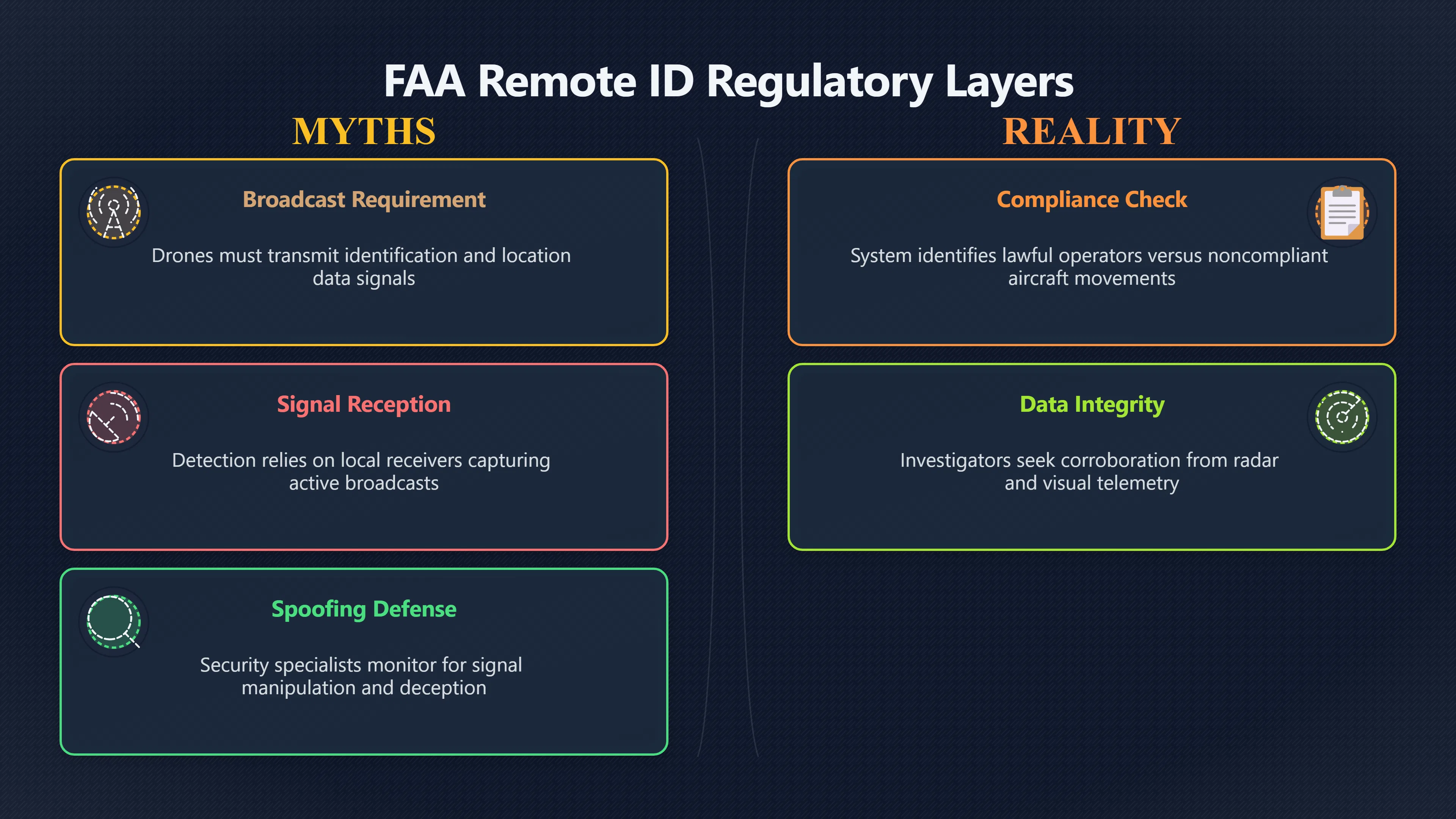
Remote ID rules require many drones to broadcast information while in flight, including an identification message and location-related data. The system was designed to give regulators, security personnel and authorised users a way to identify aircraft operating in shared airspace. In the United States, the FAA considers Remote ID a core part of integrating drones into the national airspace system.[Federal Aviation Administration]WikipediaFederal Aviation AdministrationThe Federal Aviation Administration (FAA) is a US federal government agency within the US Department of…[Federal Aviation Administration]WikipediaFederal Aviation AdministrationThe Federal Aviation Administration (FAA) is a US federal government agency within the US Department of…
For UAP investigations, this can be valuable in several ways:
- A reported object can sometimes be matched to a known drone flight.
- Investigators may be able to determine whether the aircraft was operating legally.
- Drone activity near airports, infrastructure or sensitive facilities can sometimes be distinguished from unknown objects more quickly.
- Multiple public reports can be compared against recorded drone operations rather than relying solely on witness testimony.[Federal Aviation Administration]WikipediaFederal Aviation AdministrationThe Federal Aviation Administration (FAA) is a US federal government agency within the US Department of…[Legal Information Institute]law.cornell.eduLegal Information Institute14 CFR § 89.315Minimum message elements broadcast by…Remote identification broadcast modules must be capable of broadcasting the following remote ide…
In principle, Remote ID reduces the number of sightings that remain unidentified simply because nobody knows who was flying nearby. This is particularly important in an era when drones are common enough to generate frequent reports from pilots, police officers and members of the public.
Where identification still breaks down
The strongest misconception about Remote ID is that every drone in the sky becomes instantly identifiable. In practice, the system only works when several conditions are met.
First, the aircraft must actually be subject to the rule and operating compliantly. A drone flown illegally, modified to avoid compliance or operating outside regulatory requirements may not provide useful identification information. Remote ID therefore works best against lawful operators rather than against individuals intentionally avoiding detection.[Federal Aviation Administration]WikipediaFederal Aviation AdministrationThe Federal Aviation Administration (FAA) is a US federal government agency within the US Department of…[2eCFR]ecfr.gov14 CFR Part 89 – Remote Identification of Unmanned Aircraft(i) The unmanned aircraft used in the operation must be equipped with a remot…
Second, identification depends on receiving the broadcast. The FAA ultimately adopted a broadcast-based approach rather than a universal network-reporting system. That choice simplified implementation but also means the information is not automatically available everywhere through a central tracking database. Detection depends on appropriate receivers being present and able to capture the signal.[jrupprechtlaw.com]jrupprechtlaw.comThe broadcast-based…Read more…
Third, many UAP reports are generated after the fact. A witness may report a strange light hours or days later. By that point, investigators may no longer have access to the information needed to connect the sighting to a particular drone operation. The problem is often less about identification technology than about timing, evidence preservation and data access.
Visual ambiguity also remains a major obstacle. A distant light seen from a moving aircraft may be reported as a drone when it is something else entirely. Conversely, a genuine drone may be perceived as larger, faster or more unusual than it really was. Remote ID does not correct errors in human perception; it only assists when a specific aircraft can be matched to a broadcast signal.

The noncompliance problem
The cases most likely to become public mysteries are often the same cases least likely to benefit from Remote ID.
A hobbyist flying legally in a suburban park is relatively easy to identify. A report involving a suspected intrusion near restricted airspace, a sensitive military site or a remote location may involve aircraft that are harder to trace. Whether because of noncompliance, technical limitations or simple absence of usable data, these incidents can remain unresolved even when Remote ID exists as a regulatory requirement.[NBAA]nbaa.orgfaa now fully enforcing remote id rule for uas operationsFAA Now Fully Enforcing Remote ID Rule for UAS OperationsMar 18, 2024 — The FAA's Remote ID rule requires UASs used for recreation, b…
This creates a paradox in public debate. Successful identifications rarely become famous UAP stories because they are resolved quickly. The reports that attract attention are disproportionately those where identification systems fail, where evidence is incomplete or where investigators cannot confidently connect an observation to a known aircraft.
Concerns about spoofing and data trust
Another limitation involves confidence in the data itself. Remote ID is designed as an identification aid, not as a guarantee against every form of deception. Researchers, regulators and drone-security specialists have long discussed the possibility of signal manipulation, false identifiers or other forms of spoofing, even if such activity is not believed to account for most sightings. The existence of these concerns means that a broadcast signal may be an important piece of evidence, but investigators generally seek corroboration from other sources such as radar, visual observations, telemetry or additional sensor data.[arXiv]arxiv.orgExperiments with a LoRaWAN-Based Remote ID System for Locating Unmanned Aerial Vehicles (UAVs)April 16, 2020…
For UAP investigations, this matters because identification claims must be defensible. A single digital signal may not fully resolve a controversial case if other evidence points in a different direction.
Why enforcement cases differ from UAP claims
Remote ID was primarily created as an aviation safety and accountability tool, not as a UAP investigation system. That distinction explains why enforcement success does not automatically translate into fewer mystery reports.
An enforcement case asks a relatively narrow question: who was operating this drone and were they complying with the rules? A UAP investigation often asks a broader question: what exactly was observed, how reliable is the evidence and can the event be reconstructed with confidence?
Those are not the same task.
A drone operator may be identified through Remote ID while witnesses continue to disagree about what they saw. Conversely, a sighting may strongly resemble a drone but lack the evidence necessary to link it to a specific aircraft. In both situations, Remote ID contributes useful information without fully resolving the underlying claim.
This distinction appears repeatedly in official UAP work. The Pentagon’s All-domain Anomaly Resolution Office (AARO) has reported resolving many cases as ordinary objects including drones, aircraft, birds and balloons, while also noting that unresolved cases often suffer from incomplete or insufficient sensor data. The challenge is frequently not the absence of possible explanations but the absence of evidence strong enough to confirm one.[U.S. Department of War]war.govdr jon kosloski director aaro media roundtable on the fy24 consolidated annualDepartment of WarDr. Jon Kosloski, Director, AARO, Media Roundtable on the…14 Nov 2024 — AARO has successfully resolved hundreds of ca…[ODNI]dni.govODNI[PDF] the department of defense all-domain anomaly resolution officeMay 1, 2023 to June 1, 2024 and all UAP reports from any previous time periods that were

Why drone mysteries are likely to persist
Remote ID will probably reduce some categories of mistaken UAP reports over time, especially those involving ordinary recreational and commercial drone activity. It provides investigators with a new source of evidence that did not exist during earlier decades of UFO reporting. Yet it does not eliminate the underlying conditions that generate aerial mysteries.
Witnesses will still misjudge distance and speed. Some operators will remain noncompliant. Not every report will contain usable sensor data. Detection coverage will remain uneven. And some reports will arrive too late for investigators to reconstruct events confidently.[Federal Aviation Administration]WikipediaFederal Aviation AdministrationThe Federal Aviation Administration (FAA) is a US federal government agency within the US Department of…
For that reason, Remote ID is best understood as a filtering tool rather than a final solution. It can help remove many ordinary drones from the pool of unexplained sightings, but the remaining cases will continue to include a mixture of incomplete observations, unresolved incidents and genuine uncertainty. In the broader discussion around UAPs and the disclosure movement, that means better drone identification can reduce confusion without making aerial mysteries disappear.
Amazon book picks
Further Reading
Books and field guides related to Remote ID limits in drone UAP reports. Use these as the next step if you want deeper reading beyond the article.
The Demon-Haunted World
Rating: 4.5/5 from 43 Google Books ratings
Relevant to evidence evaluation in ambiguous sightings.
American Cosmic
More than half of American adults and more than seventy-five percent of young Americans believe in intelligent extraterrestrial life. Thi...
eBay marketplace picks
Marketplace Samples
Live-tested eBay searches with available results related to this page.


Endnotes
1.
Source: faa.gov
Title: remote id
Link:https://www.faa.gov/uas/getting_started/remote_id
Source snippet
Safety and...Read more...
2.
Source: faa.gov
Link:https://www.faa.gov/uas/getting_started/remote_id/industry
Source snippet
Drone technology is...Read more...
3.
Source: ecfr.gov
Link:https://www.ecfr.gov/current/title-14/chapter-I/subchapter-F/part-89
Source snippet
14 CFR Part 89 -- Remote Identification of Unmanned Aircraft(i) The unmanned aircraft used in the operation must be equipped with a remot...
4.
Source: nbaa.org
Title: faa now fully enforcing remote id rule for uas operations
Link:https://nbaa.org/aircraft-operations/emerging-technologies/uas/faa-now-fully-enforcing-remote-id-rule-for-uas-operations/
Source snippet
FAA Now Fully Enforcing Remote ID Rule for UAS OperationsMar 18, 2024 — The FAA's Remote ID rule requires UASs used for recreation, b...
5.
Source: faa.gov
Title: ends discretionary enforcement policy drone remote identification
Link:https://www.faa.gov/newsroom/faa-ends-discretionary-enforcement-policy-drone-remote-identification
Source snippet
Federal Aviation AdministrationFAA Ends Discretionary Enforcement Policy on Drone...15 Mar 2024 — Pilots who operate drones that are req...
6.
Source: jrupprechtlaw.com
Link:https://jrupprechtlaw.com/section-107-53-automatic-dependent-surveillance-broadcast-ads-b-out-prohibition/
Source snippet
The broadcast-based...Read more...
7.
Source: arxiv.org
Link:https://arxiv.org/abs/2004.07435
Source snippet
Experiments with a LoRaWAN-Based Remote ID System for Locating Unmanned Aerial Vehicles (UAVs)April 16, 2020...
Published: April 16, 2020
8.
Source: war.gov
Title: dr jon kosloski director aaro [media]({{ ‘media/’ | relative_url }}) roundtable on the fy24 consolidated annual
Link:https://www.war.gov/News/Transcripts/Transcript/Article/3965734/dr-jon-kosloski-director-aaro-media-roundtable-on-the-fy24-consolidated-annual/
Source snippet
Department of WarDr. Jon Kosloski, Director, AARO, Media Roundtable on the...14 Nov 2024 — AARO has successfully resolved hundreds of ca...
9.
Source: aaro.mil
Link:https://www.aaro.mil/
Source snippet
AARO HomeUnidentified Anomalous Phenomena (UAP) means (A) airborne objects that are not immediately identifiable; (B) transmedium objects...
10.
Source: aaro.mil
Title: UAP Imagery
Link:https://www.aaro.mil/UAP-Cases/Official-UAP-Imagery/
Source snippet
The United States European Command submitted a report of an unidentified anomalous phenomenon to the All-domain Anomaly Resolution Of...
11.
Source: aaro.mil
Title: UAP Case Resolution Reports
Link:https://www.aaro.mil/UAP-Cases/UAP-Case-Resolution-Reports/
Source snippet
Puerto Rico Case Resolution. On April 26, 2013, an infrared sensor onboard a U.S. Customs and Border Protection aircraft captured foo...
Published: April 26, 2013
12.
Source: aaro.mil
Link:https://www.aaro.mil/Submit-A-Report/
13.
Source: faa.gov
Link:https://www.faa.gov/
14.
Source: faa.gov
Link:https://www.faa.gov/sites/faa.gov/files/2021-08/RemoteID_Final_Rule.pdf
Source snippet
to have an Internet connection to a Remote ID USS, the FAA...Read more...
15.
Source: faa.gov
Link:https://www.faa.gov/uas
Source snippet
national airspace.Read more...
16.
Source: jrupprechtlaw.com
Title: remote id compliance research
Link:https://jrupprechtlaw.com/remote-id-compliance-research/
Source snippet
11 Dec 2025 — It requires that drones manufactured in the United States are produced to standard remote ID specifications. Part 89 also a...
17.
Source: war.gov
Title: dod examining unidentified anomalous phenomena
Link:https://www.war.gov/News/News-Stories/Article/Article/3965403/dod-examining-unidentified-anomalous-phenomena/
Source snippet
14 Nov 2024 — "AARO has successfully resolved hundreds of cases in its holdings to commonplace objects such as balloons, birds, drones, s...
18.
Source: war.gov
Title: dod working to better understand resolve anomalous phenomena
Link:https://www.war.gov/News/News-Stories/Article/Article/3368109/dod-working-to-better-understand-resolve-anomalous-phenomena/
Source snippet
DOD Working to Better Understand, Resolve Anomalous...19 Apr 2023 — AARO team scientists have taken important steps to improve UAP data...
19.
Source: law.cornell.edu
Title: Legal Information Institute14 CFR § 89.315
Link:https://www.law.cornell.edu/cfr/text/14/89.315
Source snippet
Minimum message elements broadcast by...Remote identification broadcast modules must be capable of broadcasting the following remote ide...
20.
Source: Wikipedia
Title: Remote ID
Link:https://en.wikipedia.org/wiki/Remote_ID
Source snippet
Remote IDRemote ID is a regulation of the US Federal Aviation Administration (FAA) that requires registered drones—unmanned aircraft s...
21.
Source: Wikipedia
Title: Federal Aviation Administration
Link:https://en.wikipedia.org/wiki/Federal_Aviation_Administration
Source snippet
Federal Aviation AdministrationThe Federal Aviation Administration (FAA) is a US federal government agency within the US Department of...
22.
Source: support.dji.com
Link:https://support.dji.com/help/content?customId=en-us03400007712&lang=en&re=US&spaceId=34
Source snippet
Remote Identification - Support - DJIAccording to the FAR Part 89 Remote ID regulations, the RID compliance for American users starts fro...
23.
Source: uavcoach.com
Title: remote id
Link:https://uavcoach.com/remote-id/
Source snippet
Has Arrived—Here's Everything You Need to...4 Apr 2026 — The FAA's Remote ID rule is in effect for all drone operations for any drone th...
24.
Source: dronepilotgroundschool.com
Title: remote id
Link:https://www.dronepilotgroundschool.com/remote-id/
Source snippet
Understanding Remote ID: A Comprehensive GuideThe Remote ID rule applies to all drone operations for any drone that weighs.55 to 55 pounds...
Additional References
25.
Source: auvsi.org
Link:https://www.auvsi.org/news/faas-remote-id-rule-will-enable-drone-integration/
Source snippet
FAA's Remote ID Rule Will Enable Drone IntegrationBy harmonizing the needs of commercial and security stakeholders, Remote ID will enable...
26.
Source: facebook.com
Title: the latest aaro report on uaps which was released in late 2024 touched on hundre
Link:https://www.facebook.com/nbc10/posts/the-latest-aaro-report-on-uaps-which-was-released-in-late-2024-touched-on-hundre/1403981808439501/
Source snippet
The latest AARO report on UAPs, which was released in late 2024...February 20, 2026 — The latest AARO report on UAPs, which was released...
Published: February 20, 2026
27.
Source: wiley.law
Title: alert FAA Adopts Final Rules for UAS Remote ID Flights over People and at Night
Link:https://www.wiley.law/alert-FAA-Adopts-Final-Rules-for-UAS-Remote-ID-Flights-over-People-and-at-Night
Source snippet
FAA Adopts Final Rules for UAS Remote ID, Flights over...Dec 29, 2020 — The Federal Aviation Administration (FAA) released long-awaited...
28.
Source: media.defense.gov
Title: DOPSR 2024 0263 AARO HISTORICAL RECORD REPORT VOLUME 1 2024
Link:https://media.defense.gov/2024/Mar/08/2003409233/-1/-1/0/DOPSR-2024-0263-AARO-HISTORICAL-RECORD-REPORT-VOLUME-1-2024.PDF
Source snippet
defense.gov[PDF] AARO Historical Record Report Volume 1 - Department of WarMarch 8, 2024 — SECTION IV: Accounts of USG UAP Investigatory...
Published: March 8, 2024
29.
Source: noaa.gov
Title: Unidentified Anomalous Phenomena (UAP) and AARO Records
Link:https://www.noaa.gov/information-technology/foia-reading-room/unidentified-anomalous-phenomena-uap-and-aaro-records
Source snippet
October 21, 2025 — Documents released under the Freedom of Information Act (FOIA) related to UAP and AARO activities, oversight, and corr...
Published: October 21, 2025
30.
Source: youtube.com
Link:https://www.youtube.com/watch?v=xW1vHeZXkGM
Source snippet
Remote ID Rule for FAA Part 107 Drone OperationThe fa does not want drones flying in the air unless they have a remote ID broadcast going...
31.
Source: defensescoop.com
Title: uap aaro chief unveils pentagon annual caseload analysis new efforts
Link:https://defensescoop.com/2024/11/14/uap-aaro-chief-unveils-pentagon-annual-caseload-analysis-new-efforts/
Source snippet
'The truly anomalous': New AARO chief unveils Pentagon's...14 Nov 2024 — “AARO has successfully resolved hundreds of cases in its holdin...
32.
Source: twz.com
Title: the newly released government ufo archives will leave you shrugging
Link:https://www.twz.com/news-features/the-newly-released-government-ufo-archives-will-leave-you-shrugging
Source snippet
The Newly Released Government UFO Archives Will...8 May 2026 — It is worth noting here that AARO had previously released multiple tranch...
Published: May 2026
33.
Source: dronelife.com
Title: kittyhawk on eliminating the network requirement for remote id
Link:https://dronelife.com/2021/01/05/kittyhawk-on-eliminating-the-network-requirement-for-remote-id/
Source snippet
Kittyhawk on network requirement for remote IDJan 5, 2021 — The final rule was published last week, and the elimination of the network re...
34.
Source: reddit.com
Title: This report remains unresolved due to lack of technical data
Link:https://www.reddit.com/r/UFOs/comments/1ko9q2o/aaro_has_posted_another_unresolved_case_video/
Source snippet
AARO has posted another unresolved case (video): "This footage...May 16, 2025 — This footage, captured by an infrared sensor in 2024, wa...
Published: May 16, 2025
Topic Tree