Within UAP Disclosure
Are Drones Making UFO Reports Harder?
Modern drones and balloons complicate UAP reporting because they can appear near sensitive sites and look unusual on sensors.
On this page
- Why drones create new identification problems
- How balloons enter official case resolutions
- What sensitive site reports need to confirm
Page outline Jump by section
Introduction
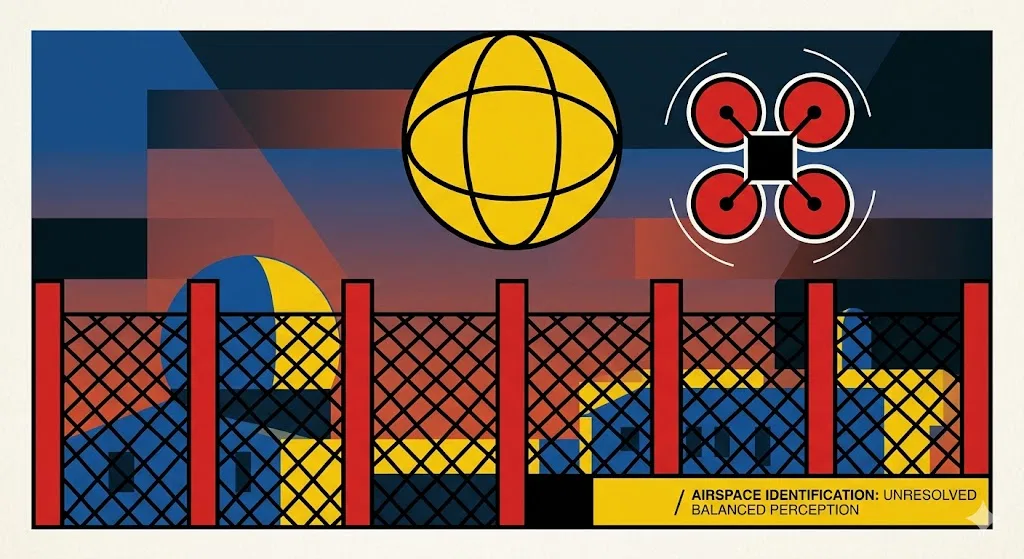
Drones and balloons are making UFO and UAP reporting harder because they add more real objects to already crowded skies while often leaving weak evidence behind: a distant light, a short infrared clip, a radar return, a witness estimate of size, or an object seen near a sensitive site. That does not mean every UAP report is “just a drone” or “just a balloon”. It means investigators now have to sort ordinary, experimental, commercial, hobbyist, law-enforcement, military and weather-related objects before treating a case as genuinely anomalous.
This matters for the UFO disclosure movement because drones and balloons cut both ways. They support the movement’s argument that governments need better reporting, declassification and sensor standards, but they also weaken claims built from ambiguous images or dramatic witness language alone. A serious disclosure process has to separate national-security airspace problems from mystery narratives, and it has to do so without either ridicule or overreaction.
Why drones create new identification problems
The basic problem is not that drones are mysterious technology. It is that they are small, mobile, increasingly common, sometimes quiet, sometimes lit in unfamiliar ways, and often seen under conditions that make human judgement unreliable. The US Federal Aviation Administration reports hundreds of thousands of registered drones and says reports of unmanned aircraft sightings near airports remain high, with more than 100 such reports near airports each month. That background traffic gives pilots, police, base security and civilians far more opportunities to see something real but hard to classify quickly.[Federal Aviation Administration]faa.govSource details in endnotes.
Drones also blur old assumptions about what counts as “strange”. A hovering object with lights no longer implies a helicopter, a planet, or a conventional aircraft. A small quadcopter can hover, drift, accelerate, descend behind trees, vanish behind buildings, or appear to move erratically when seen from a moving aircraft. A fixed-wing drone can look more like a small aircraft. Multiple drones can appear coordinated even when they are flown independently, and a single light can become a “formation” when observers combine sightings from different places and times.
The New Jersey drone scare of late 2024 showed how quickly this confusion can scale. Federal agencies said they had reviewed technical data and public tips and assessed the sightings as a mixture of lawful commercial, hobbyist and law-enforcement drones, plus manned aircraft, helicopters and even stars mistakenly reported as drones. The FBI and DHS also said they had no evidence at that time of a national-security threat, public-safety threat or foreign nexus.[Federal Aviation Administration]faa.govSource details in endnotes.
That episode is useful because it was not simply a debunking story. It showed a real governance problem: people were seeing things, some reports may have involved actual drones, local officials wanted clearer answers, and federal authorities struggled to explain the difference between “we have not found a threat” and “nothing happened”. In UAP politics, that distinction matters. Poor communication can make ordinary explanations sound evasive, while public anxiety can make weak evidence seem stronger than it is.
Why balloons keep appearing in official UAP resolutions
Balloons are a recurring source of UAP confusion because they can be simple, cheap and physically odd-looking. Weather balloons, research balloons, advertising balloons, party balloons and balloon clusters can drift at altitude, reflect sunlight, appear dark in infrared, change shape as they rotate, and move with winds rather than engines. From below or through a military sensor, a balloon can look like an object with no obvious means of propulsion.
AARO’s public case material makes this point directly. Its official imagery page includes multiple Europe 2022 cases resolved as balloons, including PR-004, PR-005, PR-006, PR-009 and PR-010, each involving infrared footage submitted by US European Command. The same page also includes unresolved cases and cases still undergoing analysis, which is important: balloon explanations are common in some batches, but they are not used as a blanket answer for every file.[AARO]aaro.milOpen source on aaro.mil.
The Al Taqaddum case is especially clear. AARO’s case-resolution page says the object did not display anomalous behaviour or capabilities and was consistent with a cluster of fully and partially inflated balloons. That is a useful example because it addresses both appearance and behaviour: the question is not only “does it look like a balloon?”, but whether the observed motion, shape, sensor signature and context fit a balloon better than alternatives.[AARO]aaro.milOpen source on aaro.mil.
AARO’s 2024 annual reporting also shows why balloons and drones are not marginal footnotes. During the reporting period, AARO resolved 49 cases as prosaic objects such as balloons, birds and unmanned aircraft systems, and recommended hundreds more for closure pending peer review. Defence reporting also quoted AARO leadership saying the office had resolved hundreds of cases to commonplace objects including balloons, birds, drones, satellites and aircraft.[U.S. Department of War]war.govdod examining unidentified anomalous phenomenadod examining unidentified anomalous phenomena
What sensors can make look stranger than it is
Many UAP debates treat video as if it were self-explanatory. In practice, sensor footage often needs aircraft position, camera settings, range, lens behaviour, wind data, radar correlation and target motion modelling before a useful conclusion can be reached. An infrared clip can show that something was physically present without proving that it was fast, large, self-propelled or exotic.
NASA’s UAP work has repeatedly stressed this data problem. NASA defines UAP as observations that cannot be identified as aircraft or known natural phenomena from a scientific perspective, while also noting that there are too few high-quality observations to draw firm scientific conclusions about many cases. Its UAP study was framed around improving data collection and analysis rather than re-litigating every famous sighting.[NASA]nasa.govOpen source on nasa.gov.
This is where drones and balloons become a critique of weak disclosure claims. A blurry clip near a base may be important enough to investigate, but it does not automatically carry the strongest interpretation placed on it by commentators. Without range and calibration, a small nearby object can be mistaken for a large distant one. Without wind data, a balloon can seem to move with intent. Without Remote ID, radio-frequency detection, radar tracks or operator identification, a drone sighting can remain unresolved even when the most plausible category is still ordinary aviation activity.
The scientific proposals that take UAP seriously tend to move in the same direction: better instruments, multiple sensors and triangulation. The Galileo Project’s proposed ground-based observatories, for example, emphasise wide-field and narrow-field cameras, radar-derived range and kinematics, radio-spectrum monitoring, microphones and environmental sensors so that artefacts can be recognised and real detections corroborated.[arXiv]arxiv.orgSource details in endnotes.
Sensitive-site reports need a higher confirmation bar
Reports near military bases, nuclear sites, airports, power infrastructure or major public events deserve attention even when the objects are ordinary drones or balloons. The risk is not only “aliens versus not aliens”. A drone over restricted airspace may be reckless, criminal, intelligence-related, or simply misidentified. A balloon at altitude may be harmless, scientific, commercial, or part of surveillance activity. The location raises the stakes, but it does not by itself identify the object.
The drone incursions reported around US military facilities illustrate this tension. Journalism on the 2023 Langley Air Force Base incidents described drones over restricted military airspace for many days, while later East Coast sightings generated thousands of public reports and political pressure. Yet the official multi-agency position on the 2024 New Jersey wave was that the sightings examined to that point included lawful drones, aircraft and mistaken reports, with no identified anomalous activity or national-security risk over civilian airspace.[The Wall Street Journal]wsj.comdrones military pentagon defense 331871f4drones military pentagon defense 331871f4
A careful sensitive-site report should therefore try to confirm several things before becoming part of a UAP disclosure claim:
- Was there a physical object? Corroboration may come from visual observation, radar, infrared, acoustic detection, radio-frequency monitoring or recovered debris.
- Was it actually in restricted or sensitive airspace? A light seen from a base is not necessarily over the base.
- Was the object a drone, balloon, aircraft, bird, satellite or star? Each category has different signatures and different policy implications.
- Was there operator or origin data? Remote ID, launch location, flight authorisation, recovered hardware or communications can turn a mystery into an enforcement case.
- Did it show genuinely anomalous performance? Claims of extreme acceleration, transmedium travel, silent hovering or impossible manoeuvres require calibrated data, not just impressions.
Remote ID helps, but it is not a magic solution. The FAA says compliant drones can broadcast identification and location information about the drone and control station, either through built-in Remote ID or a broadcast module. That improves accountability for many lawful drones, but it does not automatically solve non-compliant flights, spoofing concerns, military secrecy, weak public reporting, or ordinary visual misidentification.[Federal Aviation Administration]faa.govSource details in endnotes.
How this changes the disclosure debate
Drones and balloons make the disclosure movement more complicated because they create two opposite temptations. One temptation is to dismiss too much: if many UAP cases resolve as balloons or drones, officials may underplay reports that genuinely involve airspace incursions, intelligence gaps or unusual sensor data. The other temptation is to overread too much: if agencies cannot immediately identify a drone swarm, a balloon cluster or a faint infrared object, advocates may treat temporary uncertainty as evidence of hidden non-human technology.
The stronger position is more demanding than either. It accepts that many reports will have ordinary explanations while insisting that the ordinary explanations must be demonstrated, not merely asserted. It also accepts that unresolved does not mean extraordinary. In the most useful version of disclosure, releasing records is not just about satisfying curiosity; it is about showing how cases were handled, what data were missing, which identifications were made, and why some files remain unresolved.
Balloons and drones also reveal why the word “UAP” can be both helpful and misleading. It is helpful because it avoids jumping straight to “alien spacecraft”. It is misleading when people hear “unidentified” as a permanent status rather than a temporary investigative condition. A case can begin as a UAP and end as a balloon. A drone report can be serious without being exotic. A sensitive-site sighting can justify concern without proving advanced technology.
The practical lesson for readers is simple: modern UAP confusion is increasingly an airspace-identification problem before it is a cosmic mystery. Drones and balloons do not explain every case, but they explain enough cases to change the evidential standard. The more crowded and sensor-rich the sky becomes, the more disclosure claims will need the unglamorous details: timing, location, range, wind, flight permissions, sensor metadata, operator traces, chain of custody and peer review. Without those details, the same object can become a safety incident, a spy scare, a viral UFO, or a closed balloon case depending on who sees it first.
Amazon book picks
Further Reading
Books and field guides related to Are Drones Making UFO Reports Harder?. Use these as the next step if you want deeper reading beyond the article.
The UFO Experience
Useful for sorting misidentifications from genuinely unresolved reports.
The Demon-Haunted World
Rating: 4.5/5 from 43 Google Books ratings
Helps readers assess ambiguous observations without overclaiming.
Drone Warfare
Gives broader context for how drones complicate airspace and security debates.
eBay marketplace picks
Marketplace Samples
Live-tested eBay searches with available results related to this page.


Endnotes
1.
Source: faa.gov
Link:https://www.faa.gov/node/26
2.
Source: faa.gov
Title: uas sightings report
Link:https://www.faa.gov/uas/resources/public_records/uas_sightings_report
3.
Source: faa.gov
Title: dhs fbi faa dod joint statement ongoing response reported drone sightings
Link:https://www.faa.gov/newsroom/dhs-fbi-faa-dod-joint-statement-ongoing-response-reported-drone-sightings
4.
Source: fbi.gov
Title: joint dhs fbi statement on reports of drones in new jersey
Link:https://www.fbi.gov/news/press-releases/joint-dhs-fbi-statement-on-reports-of-drones-in-new-jersey
5.
Source: aaro.mil
Link:https://www.aaro.mil/UAP-Cases/Official-UAP-Imagery/
6.
Source: aaro.mil
Link:https://www.aaro.mil/UAP-Cases/UAP-Case-Resolution-Reports/
7.
Source: war.gov
Title: dod examining unidentified anomalous phenomena
Link:https://www.war.gov/News/News-Stories/Article/Article/3965403/dod-examining-unidentified-anomalous-phenomena/
8.
Source: nasa.gov
Link:https://www.nasa.gov/news-release/nasa-to-release-discuss-unidentified-anomalous-phenomena-report/
9.
Source: science.nasa.gov
Link:https://science.nasa.gov/uap/faqs/
10.
Source: arxiv.org
Link:https://arxiv.org/abs/2305.18566
11.
Source: faa.gov
Title: remote id
Link:https://www.faa.gov/uas/getting_started/remote_id
12.
Source: arxiv.org
Title: arXiv TBRD: TESLA Authenticated UAS Broadcast Remote ID
Link:https://arxiv.org/abs/2510.11343
13.
Source: dhs.gov
Link:https://www.dhs.gov/archive/news/2024/12/12/joint-dhsfbi-statement-reports-drones-new-jersey
14.
Source: faa.gov
Title: report uas sighting
Link:https://www.faa.gov/uas/contact_us/report_uas_sighting
15.
Source: faa.gov
Link:https://www.faa.gov/uas
16.
Source: faa.gov
Title: sightings reports
Link:https://www.faa.gov/uas/public_safety_gov/sightings_reports
17.
Source: faa.gov
Title: drone detection testing
Link:https://www.faa.gov/newsroom/faa-drone-detection-testing
18.
Source: faa.gov
Title: restricting drones near critical infrastructure sites
Link:https://www.faa.gov/newsroom/restricting-drones-near-critical-infrastructure-sites
19.
Source: faa.gov
Title: contact us
Link:https://www.faa.gov/uas/contact_us
20.
Source: faadronezone-access.faa.gov
Link:https://faadronezone-access.faa.gov/
21.
Source: faa.gov
Link:https://www.faa.gov/data_research/aviation/aerospace_forecasts/2025-uas-and-aam-summary.pdf
22.
Source: faa.gov
Link:https://www.faa.gov/sites/faa.gov/files/2021-08/RemoteID_Final_Rule.pdf
23.
Source: faa.gov
Title: drone survey
Link:https://www.faa.gov/uas/drone-survey
24.
Source: faa.gov
Title: register drone
Link:https://www.faa.gov/uas/getting_started/register_drone
25.
Source: science.nasa.gov
Title: uap independent study team final report
Link:https://science.nasa.gov/wp-content/uploads/2023/09/uap-independent-study-team-final-report.pdf
26.
Source: nasa.gov
Link:https://www.nasa.gov/
27.
Source: science.nasa.gov
Link:https://science.nasa.gov/uap/
28.
Source: nasa.gov
Title: update nasa shares uap independent study report names director
Link:https://www.nasa.gov/news-release/update-nasa-shares-uap-independent-study-report-names-director/
29.
Source: war.gov
Title: dr jon kosloski director aaro [media]({{ ‘media/’ | relative_url }}) roundtable on the fy24 consolidated annual
Link:https://www.war.gov/News/Transcripts/Transcript/Article/3965734/dr-jon-kosloski-director-aaro-media-roundtable-on-the-fy24-consolidated-annual/
30.
Source: war.gov
Title: department of defense releases the annual report on unidentified anomalous phen
Link:https://www.war.gov/News/Releases/Release/Article/3964824/department-of-defense-releases-the-annual-report-on-unidentified-anomalous-phen/
31.
Source: aaro.mil
Link:https://www.aaro.mil/
32.
Source: aaro.mil
Title: UNCLASSIFIED FY23 Consolidated Annual Report on UAP Oct 25 2023 1236
Link:https://www.aaro.mil/Portals/136/PDFs/UNCLASSIFIED-FY23_Consolidated_Annual_Report_on_UAP-Oct_25_2023_1236.pdf
33.
Source: news.sky.com
Link:https://news.sky.com/story/nasa-ufo-report-live-scientists-to-release-unidentified-anomalous-phenomena-findings-12960933
34.
Source: media.defense.gov
Title: FY24 CONSOLIDATED ANNUAL REPORT ON UAP 508
Link:https://media.defense.gov/2024/Nov/14/2003583603/-1/-1/0/FY24-CONSOLIDATED-ANNUAL-REPORT-ON-UAP-508.PDF
35.
Source: wsj.com
Title: drones military pentagon defense 331871f4
Link:https://www.wsj.com/politics/national-security/drones-military-pentagon-defense-331871f4
36.
Source: Wikipedia
Link:https://en.wikipedia.org/wiki/NASA
37.
Source: Wikipedia
Title: Remote ID
Link:https://en.wikipedia.org/wiki/Remote_ID
38.
Source: abcnews.com
Link:https://abcnews.com/US/us-concludes-search-2-objects-shot-alaska-lake/story?id=97304508
39.
Source: dvidshub.net
Link:https://www.dvidshub.net/video/964843/middle-east-red-balloon-2024
Additional References
40.
Source: youtube.com
Title: Lue Elizondo on drones: ‘Feds have gotta be more open’ | Vargas Reports
Link:https://www.youtube.com/watch?v=j3oO_5Jek-k
Source snippet
White House Weighs In On 'Drone' Sightings in New Jersey...
41.
Source: youtube.com
Title: White House Weighs In On ‘Drone’ Sightings in New Jersey
Link:https://www.youtube.com/watch?v=G06v6AWp4aM
Source snippet
What Was This? UAP / UFO, Drone, Weather Balloon, or Something Else?...
42.
Source: ecfr.gov
Link:https://www.ecfr.gov/current/title-14/chapter-I/subchapter-F/part-89
43.
Source: youtube.com
Title: UFO Videos Explained: Mick West’s Expert Analysis
Link:https://www.youtube.com/watch?v=-_4QF__92q0
Source snippet
Lue Elizondo on drones: 'Feds have gotta be more open' | Vargas Reports...
44.
Source: youtube.com
Title: UFO or drone? Fear grows over mysterious aircraft in New Jersey
Link:https://www.youtube.com/watch?v=4uPagcaUXjs
Source snippet
UFO Videos Explained: Mick West's Expert Analysis...
45.
Source: wesh.com
Link:https://www.wesh.com/article/bill-nelson-blue-origin-explosion-cape-canaveral/71447655
46.
Source: reddit.com
Link:https://www.reddit.com/r/UFOs/comments/1fle8fk/335_pages_of_documents_released_by_canadian/
47.
Source: instagram.com
Link:https://www.instagram.com/p/DYtju8qiUXj/
48.
Source: jrupprechtlaw.com
Link:https://jrupprechtlaw.com/drone-sightings/
49.
Source: airsight.com
Link:https://www.airsight.com/en/news/drone-langley-air-force-base
Topic Tree